



Our Licensed Immigration Advisers
Vandana Rai
LICENCE NUMBER
201400900
Himanshu Rai
LICENCE NUMBER
201501323
Tanuva (Bose) Majumdar
LICENCE NUMBER
202001075
Kaetki Rai Bhatnagar
LICENCE NUMBER
202000489
Amy Xu
LICENCE NUMBER
202401575


Skilled Migrant Category Resident Visa: Your Pathway to New Zealand
The Skilled Migrant Category Resident Visa is New Zealand’s primary pathway for skilled professionals and students who wish to make New Zealand their permanent home. This visa is designed for individuals who possess the skills, qualifications, and experience to contribute significantly to the country’s economic growth.
Unlike temporary work permits, the SMC resident visa provides you and your family the option to live in New Zealand permanently. However, it is not applicable to self-employed individuals.
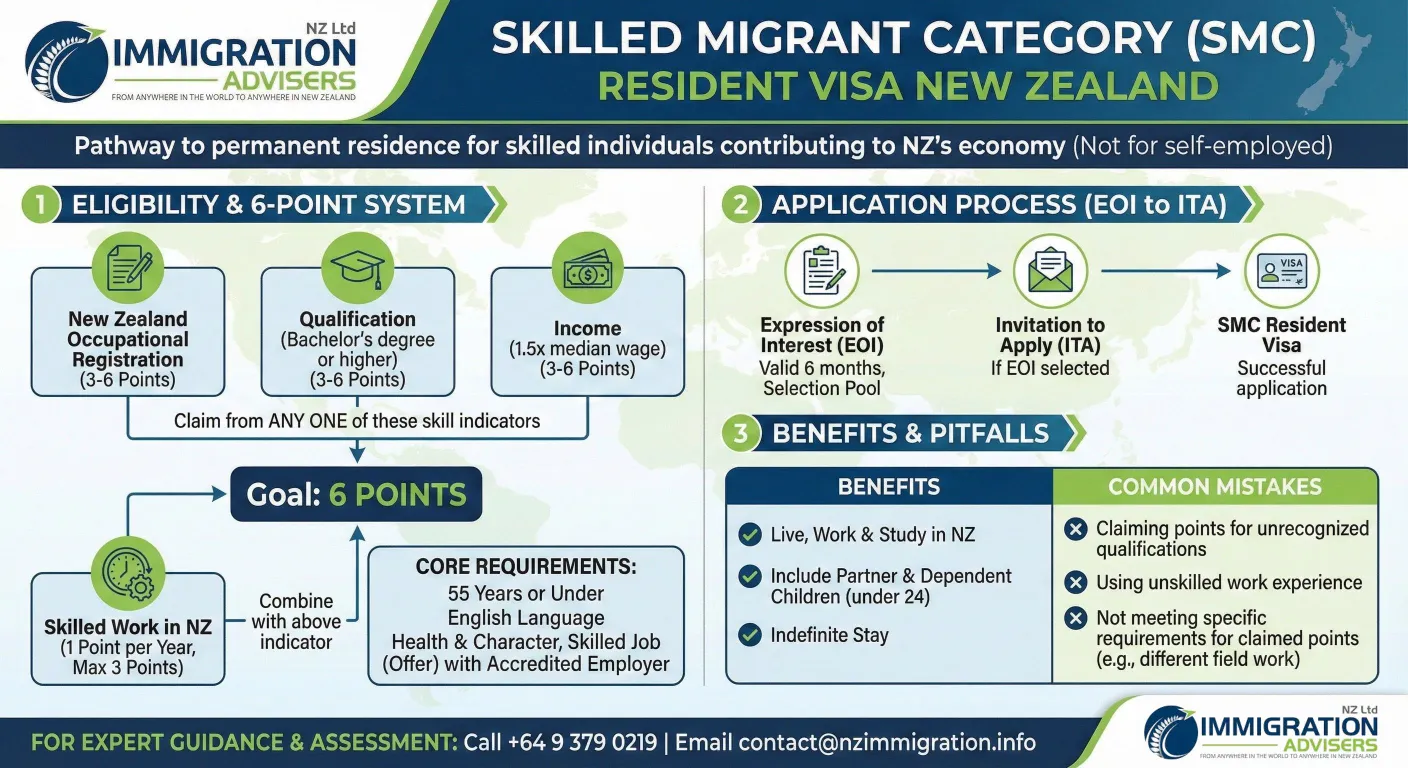
How the New 6-Point System Works
New Zealand has introduced a simplified points-based system to assess eligibility for the Skilled Migrant Visa NZ. To be invited to apply for residence, you must achieve a threshold of 6 points.
This new system is designed to provide certainty. If your Expression of Interest (EOI) demonstrates that you meet the 6-point requirement and standard eligibility criteria, you will be selected from the pool and sent an Invitation to Apply (ITA).
You can build your 6 points by combining Skill points (from one category only) with Experience points.
Claim Skill Points (3 to 6 Points)
You can claim points from only one of the following skill indicators:
- New Zealand Occupational Registration: For regulated professions (e.g., nurses, teachers, engineers) requiring registration.
- Qualification: Holding a Bachelor’s degree (NZQF Level 7) or higher.
- Income: Earning at least 1.5 times the median wage in New Zealand.
Claim Work Experience Points (1 to 3 Points)
You can top up your score by claiming 1 point for each year of skilled work experience in New Zealand, up to a maximum of 3 points.
Note: You cannot combine points from multiple skill indicators (e.g., you cannot add points for income to points for a degree). You simply choose the skill category that grants you the highest points and add your skilled work experience to reach a total of 6.
Eligibility Criteria for the Skilled Migrant Visa
To successfully secure a New Zealand SMC visa, you must meet specific foundational requirements beyond just the points score:
- Age Limit: You must be 55 years old or younger at the time of application.
- Employment: You must hold a current skilled job or a genuine job offer and be paid at or more than the median wage rate from an Accredited Employer in New Zealand.
- Language: You must meet the minimum English language standards.
- Personal Standards: You must satisfy strict health and character requirements.
Those currently in the country on a skilled migrant work visa NZ or an Accredited Employer Work Visa (AEWV) often find this the natural next step toward permanence.
Benefits of the SMC Resident Visa
Securing a skilled migrant residence visa NZ opens the door to a stable future:
- Indefinite Stay: Live in New Zealand permanently with no expiry date on your residence status.
- Family Inclusion: Your partner and dependent children (aged 24 and under) can be included in your application.
- Full Rights: Enjoy the freedom to work, live, and study in New Zealand.
Navigating Pitfalls: Common Application Mistakes
The requirements for a skilled migrant visa can be deceptive. While the 6-point system looks simple, the verification process is rigorous. Applicants often face rejection or delays due to avoidable errors.
Common issues include:
- Unverified Qualifications: Claiming points for degrees that are not on the List of Qualifications Exempt from Assessment (LQEA) without first getting an International Qualification Assessment (IQA) from NZQA.
- Misclassified Experience: Claiming points for work experience that does not match the field of your skilled job offer.
- ANZSCO Mismatches: If you rely on work experience without a current job offer in that specific field (rare but specific scenarios), the experience must align with ANZSCO Skill Levels 1, 2, or 3, or be in a comparable labor market.
If a Case Officer determines that your evidence does not support your claimed points, you may fall below the 6-point threshold, resulting in a declined application.
The Expression of Interest (EOI) Process
What is an EOI? The Expression of Interest is the first formal step in the Skilled Migrant Category Resident Visa process. It is an online submission where you inform Immigration New Zealand of your intent to apply and outline your claims for the 6 points.
Validity and Selection Under the current settings, if your EOI shows you meet the 6 points and eligibility criteria, you are generally selected promptly. However, strictly speaking, an EOI remains valid for 6 months. If you are not invited to apply within this timeframe, the EOI lapses, and you would need to submit a new one.
Skilled Migrant Category: 6-Point Calculator
Current System: The existing Skilled Migrant Category operates under the 6-point framework, where residence eligibility is primarily based on New Zealand skilled employment combined with recognised qualifications or income levels.
From August 2026: The revised system is expected to introduce a more structured points-based model with expanded weighting for age, work experience, and priority occupations, aligning residence selection more directly with labour market demand.
Here’s a comparison table showing the current New Zealand Residence Visa Points Calculator versus the proposed points system from August 2026 (based on the latest policy reforms expected to take effect). This can be used for blogs, videos, or internal reference.
Note: The August 2026 points model is based on the current draft framework released by INZ/NES updates. Exact numerical thresholds and categories may still be subject to final policy confirmation.
| Points Category | Current Points System | Proposed August 2026 Points System |
| Age | Maximum 30 points | Maximum 40 points |
| Age 20–29 | 30 | 40 |
| Age 30–39 | 25 | 35 |
| Age 40–44 | 20 | 20 |
| Age 45–49 | 10 | 10 |
| Age 50+ | 0 | 0 |
| Skilled Employment (in NZ) | Up to 50 points | Up to 50 points |
| Job Offer/Accredited Employer | 50 | 50 |
| Job in a lower wage band | Reduced point allocation but still considered | Similar structure with greater emphasis on wage thresholds |
| Work Experience | Up to 30 points | Up to 40 points |
| 2–5 years | 10 | 15 |
| 5–8 years | 15 | 20 |
| 8+ years | 30 | 25–30* (more granular breakdown) |
| Qualifications | Up to 60 points | Up to 60 points |
| Bachelor’s degree | 40 | 40 |
| Master’s / PhD | 60 | 60 |
| NZ Qualification bonus (Level 7+) | 10–15 | 15–20 |
| Bonus Points | Specific categories only | Expanded eligibility |
| Regional bonus (if applicable) | 10 | 10–15 |
| Partner skilled/not skilled | 10 | 10 |
| Study in NZ (Completed qualification) | Limited bonus | Structured bonus tied to duration & level |
| Total Maximum Possible | 200+ points total (not cumulative “pass mark”) | 240+ points (threshold for selection determined by demand) |
| Minimum Threshold | Variable based on each Expression of Interest (EOI) round | More structured threshold model with occupation tiers |
| Occupational Prioritisation | None built into points | Introduction of priority tiers (Green List or skill shortage weighted) |
| Points Refresh Frequency | Based on periodic rounds | More frequent draw rounds and transparent band tiers |
| Skill Shortage Recognition | Indirect via employment | Built into skills matrix and occupation tiers |
Need Expert Assistance?
Navigating the skilled migrant visa requirements requires precision. One wrong calculation regarding your points or ANZSCO classification can jeopardize your residency.
If you need clarity on the SMC resident visa process, assessment criteria, or want to ensure your application is error-free, contact us today.
Phone: +64 9 379 0219 Email: contact@nzimmigration.info
0k+
Successful Clients
0
Licensed Advisers
0+
5 Star Google Reviews
0+
5 Star Facebook Reviews
0+
Years of Experience
Frequently Asked Questions
Yes. One of the main benefits of the skilled migrant residence visa NZ is that you can include your partner and dependent children (aged 24 and under) in your application. If approved, they also gain resident status, allowing them to work and study in New Zealand as domestic students.
Processing times vary, but Immigration New Zealand aims to process the majority of straightforward SMC visa applications within 6 to 10 weeks. However, applications with missing documents or those requiring complex verification (e.g., external qualification assessments) may take several months.
The Green List and the Skilled Migrant Category are separate pathways. The Green List is for specific roles identified as being in high demand (like doctors or engineers) and often offers a “Straight to Residence” option. The SMC resident visa is a broader category for other skilled professionals who may not be on the Green List but can demonstrate their value through high income, qualifications, or professional registration.
Eligibility requires meeting both the point threshold and standard criteria. You are eligible if you:
- Are 55 years old or younger.
- Meet the English language requirements (e.g., IELTS 6.5).
- Have a skilled job offer from an accredited employer that pays at or above median wage rate..
- Can claim 6 eligibility points through qualifications, income, or registration, plus NZ work experience.
The main “new rule” is the simplified 6-point system, which replaced the old 180-point threshold. It is further being streamlined in August 2026. At present:
- There is no cap on the number of people who can gain residence (no more annual quota).
- You must hold a skilled job or job offer.
- Processing is streamlined for those who clearly meet the 6-point threshold.
No, generally you cannot. Under the current criteria, you must have a valid skilled job or a genuine job offer from an Accredited Employer in New Zealand to apply. Unlike previous versions of the visa, the current SMC visa NZ pathway is designed for those who have already secured employment.
You need exactly 6 points to be eligible for the SMC resident visa. You can claim these points from one skill category (Income, Qualification, or NZ Registration) and combine them with points for skilled work experience in New Zealand (1 point per year, up to 3 years).
The Skilled Migrant Category (SMC) Resident Visa is a permanent residence visa for skilled workers who want to live and work in New Zealand indefinitely. It is New Zealand’s primary pathway for experienced professionals. To qualify, you must be 55 or under, meet health and character standards, and earn 6 points under the new points-based system.
Applicants claiming points for any Level 8 or Level 9 qualification must also hold a bachelor’s degree.
The only exception is applicants with a Level 9 master’s degree gained in New Zealand, who do not
need to provide evidence of a bachelor’s degree. Where an applicant provides appropriate evidence
of a bachelor’s degree, they can get 6 points and have a straight to residence pathway. Where an
applicant does not provide evidence of a bachelor’s degree, they can get 5 points and must have 1 year
of skilled work experience in New Zealand.
Yes. Applicants with a New Zealand Level 9 master’s qualification do not need to show evidence of a
bachelor’s degree to claim 5 qualification points. They can claim 6 points if they have a NZ Level 9
master’s degree and a bachelor’s degree (from any country).
Yes. The bachelor’s degree requirement applies to all Level 8 and Level 9 qualifications. The only
exception is people who have gained a Level 9 master’s degree in New Zealand who wish to claim 5
rather than 6 points for their master’s degree.
The new residence pathways are designed to provide a pathway for skilled migrants that support New
Zealand’s economic growth. Where roles have indicators of immigration risk, including role inflation,
wage recycling and migrant exploitation, they have been placed on the red or amber lists. Occupations
were determined based on risk indicator data and frontline experience.
Officials looked at a range of data, including:
- processing data (such as declined Job Checks, AEWV visas and residence applications)
- risk indicators through the Accredited Employer Risk Monitoring and Review
- wage rates for the role
- rates of Migrant Exploitation Protection Visas
- Operational frontline insights.
Immigration risk is dynamic and it’s important that these lists shift to reflect our most up to date
understanding of risk in the system. A regular process will be run for considering what roles are on the
Disclaimer: These answers are accurate as at 5 March 2026.
lists and whether there is a need to add or remove roles. Relevant stakeholders will be consulted for
their input.
Migrants no longer need to meet the current SMC median wage at the time of applying for residence.
They only need to maintain the SMC median wage that was in effect when they began to accrue their
skilled work experience in New Zealand.
If an applicant begins to accrue their skilled work experience in New Zealand within five months of
their work visa being approved. The SMC median wage in effect at the time their work visa was granted
will apply.
Initially, ANZSCO will be used for the new SMC. INZ will introduce the National Occupation List (NOL)
into residence categories once the full transition is complete.
The timeline for when this will happen is not yet confirmed.
Currently, NOL occupations aren’t yet integrated into SMC and therefore will not be on the red or
amber lists. However, as we have not transitioned fully to the NOL, this may change as the transition
progresses.
Transitioning fully to the NOL is a significant change and will take time to complete. INZ will introduce
the NOL gradually, rather than all at once. More information will be shared as the transition
progresses.
This will mean they have two pathways. Officials will be completing the second part of the skilled
residence review in 2026 which will focus on the Green List.

Get a Free Assessment Done
GET A FREE CASE EVALUATION. CALL NOW +64 9 379 0219
or
contact@nzimmigration.info
 Happy Client Wahalathantri Family










 Home
Home
 Services

 Contact
 About
About