

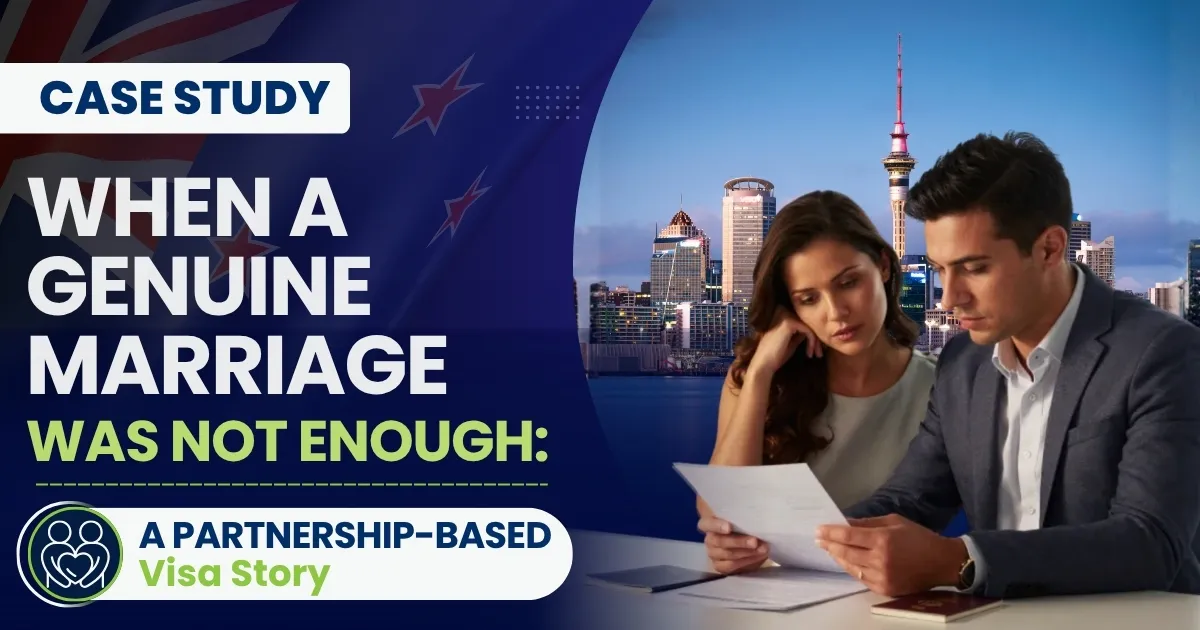
When a Genuine Marriage Was Not Enough: A Partnership Visa Story
A genuine marriage does not automatically result in a Partnership Visa approval. Immigration New Zealand must be satisfied that a relationship is genuine, stable, and likely to endure. This real Partnership Visa New Zealand case study explains how a previously declined arranged marriage application was successfully approved after a fresh application was prepared and submitted.
Here is one such case study about a couple. They were married in a traditional ceremony in India. Both families had been involved in the match for months. The bride and groom had spoken, met, and agreed. And the groom was a New Zealand citizen.
By any ordinary measure, it should have been straightforward.
It was not.
A Decision That Devastated Two Families
Mr Gurnam Singh — not his real name — had lived and worked in New Zealand for several years when he was introduced to Ms Simi Kaur — also not her real name — through the traditional arranged marriage process that remains deeply meaningful across many South Asian communities. Both families undertook the kind of careful due diligence that such introductions involve: background checks, family consultations, compatibility assessments, and extended conversations between the two families before the match was formalised.
The wedding took place in India. Shortly afterwards, Mr Singh returned to New Zealand — he had employment commitments he could not defer — while Ms Kaur remained in India, fully expecting to join her husband in New Zealand once their visa was approved.
The couple applied for the Partnership-Based Visa themselves. They gathered what they believed Immigration New Zealand required: the marriage certificate, wedding photographs, sponsorship documents, personal supporting documentation, and Form INZ 1025. They submitted the application with confidence.
Immigration New Zealand declined it.
The reasons cited were: the short period of relationship inception and development before marriage; limited evidence of the couple having lived together; insufficient documentation explaining how the relationship had developed; and concerns about whether the relationship was likely to endure.
Ms Kaur was devastated. Her family could not understand how a genuine marriage — witnessed by hundreds of people, conducted according to their cultural traditions, and supported by both extended families — had been deemed insufficient. Mr Singh and his family were equally distressed. They had done nothing wrong. They simply had not understood what Immigration New Zealand actually needed to see.
What Immigration New Zealand Actually Looks For
This is perhaps the most important thing for any couple to understand before applying for a Partnership-Based Visa in New Zealand: a marriage certificate is not evidence of a genuine relationship. It is evidence of a marriage. They are not the same thing in the eyes of immigration law.
Immigration New Zealand must be satisfied — based on the evidence placed before it — that a relationship is genuine, stable, and likely to endure. That assessment is made on the totality of the evidence submitted with the application. If the evidence does not adequately address the officer’s concerns, the application will be declined regardless of the underlying reality of the relationship.
This is not an unreasonable standard. New Zealand’s immigration system must protect against marriages of convenience, and officers cannot simply take an applicant’s word for it. But it does mean that how an application is prepared is as important as the relationship it describes.
When the couple came to me following the decline, I reviewed the decision and the original application carefully. My assessment was clear: the relationship was genuine. The application, however, had not been prepared in a way that demonstrated that genuineness to the satisfaction of Immigration New Zealand.
The question at that point was whether to challenge the decline decision or prepare a fresh application. After detailed assessment, I recommended a fresh application — the original had significant gaps in both documentation and explanation that needed to be addressed comprehensively rather than patched.
Building the Case That Should Have Been Built the First Time
The fresh application was prepared in close collaboration with Mr Singh and Ms Kaur. My task was not to invent evidence — the genuine relationship already provided everything we needed — but to present it in a way that directly and proactively addressed Immigration New Zealand’s concerns.
On the arranged marriage process:
I provided Immigration New Zealand with a detailed explanation of the cultural context — the role of both families in the introduction process, the compatibility assessments undertaken, the significance of the arranged marriage tradition within their community, and the careful due diligence conducted before the marriage was formalised. This is information that an officer assessing the application may not have if it is not explained. Assuming that an officer will simply understand the cultural context is one of the most common mistakes in self-prepared partnership visa applications.
On the limited period of living together:
Mr Singh had returned to New Zealand shortly after the wedding because of his employment obligations — not because of any lack of commitment to the marriage. That distinction needed to be explained and evidenced. I provided documentation of his employment situation and demonstrated clearly that the separation was circumstantial rather than indicative of a relationship lacking substance.
On the ongoing nature of the relationship:
Comprehensive records of daily communication were submitted — phone records, message logs, video call histories — demonstrating that the couple had maintained consistent, substantive contact across the distance. A relationship does not pause simply because two people are in different countries. The evidence needed to show that.
On financial and emotional interdependence:
Evidence of financial support, shared future planning, and the mutual commitment of both parties was submitted. Immigration New Zealand looks for the markers of a functioning partnership — not simply the existence of a marriage certificate.
On public recognition:
Additional evidence demonstrating that the relationship was recognised by family and friends on both sides was provided, alongside photographs and supporting documents showing the couple’s integration with each other’s families.
Nine Working Days
The application was approved in nine working days.
For a couple who had already been through the distress of an unexpected decline, nine working days felt remarkable. What had been months of stress and uncertainty for two families ended quickly and completely.
Ms Kaur was able to begin making concrete plans to join her husband in New Zealand. Both families, who had been anxious and confused by the original decline, were finally able to celebrate the marriage they had always believed in.
What This Case Teaches Us
I share this case — with the full knowledge and permission of the couple, whose names I have changed to protect their privacy — because it illustrates something that I see more often than I would like in my practice.
Genuine couples are being declined. Not because their relationships are not real, but because their applications do not demonstrate the reality of those relationships in the way that Immigration New Zealand’s assessment framework requires.
A marriage certificate tells an immigration officer that a marriage took place. It does not tell them how the couple met, how the relationship developed, why they have not been able to live together, what their daily contact looks like, what their financial arrangements are, or what their future together looks like. All of that must be explained, evidenced, and submitted in a form that an immigration officer can assess.
For couples from arranged marriage backgrounds — a significant proportion of the applicants I work with from South Asian, Indian, and many other communities — there is the additional layer of cultural context that an officer may not be familiar with. That context is not automatically understood. It must be explained, respectfully and comprehensively, within the application itself.
The cost of a declined application is not simply the application fee. It is the months or years of separation while a fresh application is prepared. It is the emotional toll on both partners and their families. It is the uncertainty that follows a decision that should never have been necessary.
If you or someone you know is planning to apply for a Partnership-Based Visa in New Zealand — whether as an arranged marriage, a long-distance relationship, or any other circumstance that an officer might consider unusual — please seek professional advice before you apply, not after a decline forces your hand.
The difference between a declined application and an approved one is not always the relationship. It is often the preparation.
Vandana Rai is a Licensed Immigration Adviser (IAA), Director of Immigration Advisers New Zealand Ltd, Board Director of the New Zealand Association for Migration and Investment (NZAMI), and a member of the Industry Partnership Group for the Graduate Diploma in New Zealand Immigration Advice (GDNZIA). She is based in Auckland and works with clients across New Zealand and internationally.
This article is based on a real case. Names and identifying details have been changed to protect client confidentiality. It is written for general information purposes only and does not constitute immigration advice. Every case is different — if you are considering a partnership visa application, seek advice based on your specific circumstances from a Licensed Immigration Adviser.


Author Details
 Home
Home
 Services

 Contact
 About
About