
Provide All Relevant Information - Submit Query

Student Visa

Profile Check Form

Click Here ×
S
t
u
d
e
n
t

V
i
s
a

Get in Touch

    New Zealand Government Moves To Stabilise International Education Sector

    New Zealand is one of the most preferred educational destinations globally and has attracted students worldwide. Unfortunately, the educational sector is one of the most affected sectors due to the pandemic. However, the government knows the vital role international education will play as the economy recovers and rebuilds.

    Therefore, in response to the pandemic, the New Zealand government has announced a long-term strategic recovery plan, supported by a $51.6 million investment from the COVID recovery and response fund to help stabilize New Zealand’s international education sector.

    The recovery plan comprises three parts that will run concurrently and focus on stabilizing the international education sector, strengthening it via regulatory settings, policies, and practices, and accelerating its transformation as signalled in 2018’s International Education Strategy.

    The government aims at investing in the international education recovery fund in several ways, as mentioned below.

    • $20 million will support the state and state-integrated schools.
    • $10 million will support Private Training Establishments (PTEs).
    • $1.5 million will go to the English Language Schools to deliver English language training to migrants.
    • $500,000 will go to the New Zealand Qualifications Authority (NZQA).
    • $6.6 million will be spent to ensure pastoral care and other activities for international students.
    • $10 million will be spent developing future-based products and services to drive higher onshore and offshore growth.
    • $3 million is kept for Education New Zealand (ENZ) brand’s marketing in the relevant international market.

    By implementing this comprehensive recovery plan, the government anticipates minimizing the impact on the educational sector.

    The fund allocation intends to strengthen the country’s existing education system with a higher appeal and resiliency that attracts more international students as the world looks to recover from the pandemic.

    The Education Minister of New Zealand has said that ultimately what the government wants is to have an international education system that’s mutually good for students, education providers and benefits New Zealand economically and socially.

    He also said that he is aware that much of the recovery is dependent on when New Zealand will open its borders to international students, and providers are eager to get timeframes on when any changes to the border closure will be made.

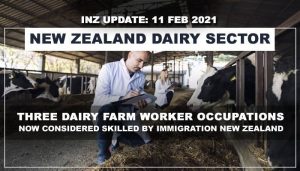
    New Zealand Dairy Sector Update: Skilled Occupations

    Changes have been made to Residence and Temporary Entry immigration instructions by Immigration New Zealand (INZ) to reflect new task descriptions developed by Statistics New Zealand, for three dairy roles under the occupation Dairy Cattle Farmer (ANZSCO 121313).

    With effect 15 February 2021, INZ will now assess the following roles based on version 1.3 of the Australian and New Zealand Standard Classification of Occupations (ANZSCO), provided by Statistics New Zealand in their Ariā classification management system :

    • Dairy Farm Manager (Skill Level 1)
    • Assistant Dairy Farm Manager (Skill Level 3)
    • Dairy Herd Manager (Skill Level 3)

    In the past, only Dairy Farm Managers were considered as skilled occupation by INZ for residence under the Skilled Migrant Category (SMC). This is a skill level 1 occupation on ANZSCO which requires either a bachelor’s degree or five years’ experience. Not everybody could meet the qualification and/or experience requirements for the skill level 1 position, thus preventing many dairy farmworkers from applying for residence under the SMC.

    What Does The Change Mean?

    The recent change now means that applicants will now also be able to apply for residence based on the above two skill level 3 positions provided they can meet the other eligibility requirements. Skill level 3 occupations generally require either three years of relevant work experience or a level 4 qualification.

    The other dairy farm occupation on the earlier version of ANZSCO is that of a Dairy Farm Worker, a skill level 5 position that made it difficult for many other farmworkers who did not meet the requirements for the skill level 1 position to apply for residence.

    The newly introduced changes will now open pathways for residence for a large number of dairy farmworkers, and will also go a long way in addressing the manpower challenges faced by employers in this industry.

    If you are working in the dairy industry or planning to take up a role, and would like to discuss the possibility of applying for residence, what it involves or whether you qualify, please email Immigration Advisers New Zealand Ltd at contact@nzimmigration.info or call us today on +64 09 3790219

    New Zealand Revives Its Economy And Employment While Keeping A Close Eye On Immigration

    Economy Back On Track

    The pandemic hit New Zealand’s economy in a significant way. However, even as the world scrambles towards the vaccine, owing to its strong base and robust measures, the country’s economy, including the job market seems to be getting back on track.

    The country’s most significant job advertising site, Seek, has reported a 19% national growth in jobs advertised in the final quarter of 2020. The number of job advertisements on the website has bounced back to nearly pre-pandemic levels.

    Finance Minister Grant Robertson says the national unemployment rate in the December 2020 quarter is promising and the trend is continuing to prove strong heading into 2021.

    Unanticipated Decline In Unemployment Rate

    The employment data from Stats NZ reflects the favourable impact of the New Zealand government’s decisive actions taken to stimulate economic recovery.

    The sectors posting the most vacancies on Job sites included IT and communications, manufacturing, transport & logistics and trades & services. However, jobs in customer-facing roles have taken a massive hit. Despite this Stats NZ said the third-quarter growth was the strongest in New Zealand’s modern history, coming off an 11% drop in the June quarter.

    Off late various indicators have conveyed that New Zealand economy is bouncing back better than expected, and labour shortages are being experienced across many industries.

    That’s good news for the citizens and the onshore migrants whose skills are back in high-demand. To ensure a consistent supply of labour to the local businesses, Immigration New Zealand (INZ) has decided to extend several work visas automatically for a defined period. These changes have impacted a large number of 192,000 migrant workers who are in New Zealand.

    Immigration Policy Changes

    Employers-assisted work visa holders whose visas were due to expire before 30th June 2021 now had their visas extended automatically for another six months. The Essential Skills Work Visa holders (earning less than $25.50) who otherwise had to leave New Zealand for 12 months after working in New Zealand for three years have their stand-down period postponed until January 2022. The Working Holiday visas stand extended for six months.

    These changes have been made to ensure the consistent accessibility of migrant workers for New Zealand employers. The visa extension is not a guarantee, and the visa holder must meet the INZ requirements to have their visas extended.

    Similarly, employers in New Zealand must adhere to the laws and regulations when hiring migrant workers. They would do well to note that while these changes allow employers to retain existing migrant workforce, they still need to undertake Labour Market Test (LMT) before hiring new employees.

    The potential completion of the COVID-19 vaccination programme in 2021 can now only further the recovery being experienced.

    Have a Question?

    If you are confused or have any queries, please get in touch with us. Talk to our licensed immigration advisers and have a proper understanding of these changes – and how they might affect you. Click here and get in touch with our team.