Provide All Relevant Information - Submit Query

Student Visa

Profile Check Form

Click Here ×
S
t
u
d
e
n
t

V
i
s
a

Get in Touch

    Current Partnership-Based Visa Instruction for The Partners of New Zealand Citizens and Residents When The Borders are Closed

    New Zealand border restrictions have kept many souls apart and this is a grim situation for the couples. But the situation is getting better for the couples staying miles apart because New Zealand borders are re-opened to those who are planning to reunite with their offshore partners. Hence, a celebratory moment for the ones who are living away from their families.

    Eligibility Criteria

    Immigration New Zealand instruction states that you may be eligible for the partnership-based visa if

    • your New Zealand partner is eligible to support your application; and
    • you and your partner are living together in a genuine and stable relationship; and
    • your partnership meets the Immigration NZ’s minimum requirement for the recognition of partnership; and
    health and character requirements are met.

    Partnership- based Visa categories

    Culturally Arrange marriage – Temporary visitor visa

    This category is for those who have married overseas to a New Zealand citizen or resident but were not able to live together after marriage due to work commitments. You must apply under this category within 3 months from the date of your wedding. To be eligible for this visa you must be able to demonstrate that the marriage follows an identified & recognized cultural tradition. You are also required to provide verifiable documentary evidence to show that you have a genuine intent to live together in a stable relationship.

    Partner of New Zealander – Temporary Visitor or work visa

    This requires you and your New Zealander partner to be living together in a genuine and stable relationship. You are required to provide verifiable documentary evidence to show that you meet the living together requirement. Based on the duration of your relationship/living together, you would be eligible for a visitor or work visa.

    Partner of New Zealander – Resident Visa (Onshore and offshore applicants)

    This requires you and your New Zealand partner to be living together in a genuine and stable relationship for at least twelve months at the time of lodgement of your application. You are required to provide documentary evidence for a minimum of 12 months to show that you meet the living together requirement.

    Critical Purpose Visitor Visa (Border exemption) Offshore applicants

    As per the criteria, citizens of ‘visa waiver’ countries are mandated to meet few policies, including living together in genuine and stable relationship criteria. For the ‘non-visa waiver’ countries the applicants should be ordinarily resident in New Zealand or traveling with their New Zealand partners.

    Common Factors considered by Immigration Officers

    ● Genuineness of the relationship
    ● Duration and stability of the relationship
    ● Financial dependence/interdependence
    ● Future commitment towards the relationship
    ● Children together and their care-taking arrangements
    ● Public recognition of the relationship
    ● Intentions for entering into the relationship
    ● Commitment to a shared life

    The most common reason for not receiving a partnership visa

    • INZ is not satisfied that you are in a genuine and stable relationship with a New Zealand citizen/resident.
    • There are outstanding Bona fides/Character issues/Health issues.

    These situations demand a well-skilled and informed expert who can assure your visa approval and this calls for experts’ assistance. Our team of experienced licensed immigration advisers is here to assist you with all your immigration-related queries and confusions, please contact Immigration Advisers New Zealand Ltd by sending an email at contact@nzimmigration.info or call us on +64 09 3790219

    New Zealand Border Exception Criteria For Partners And Dependents Of Citizens/Residents

    Do you wish to enter New Zealand? If the answer is yes, you must be aware of the options Immigration New Zealand (INZ) has for you.

    Even though the borders are currently closed for most travellers, partners of New Zealand citizens/residents can travel to New Zealand if they hold a critical purpose visitor visa or relationship-based visa. As you would already know, entry to New Zealand from all countries remains strictly controlled to prevent the spread of COVID-19.

    Partners of New Zealand resident/citizen who are currently outside New Zealand

    Those applicants who do not hold a relationship-based visa and are currently outside New Zealand can apply for a border exception.

    However, to do that under this category and criteria, you must prove that you are in a genuine and stable relationship and intend to travel to New Zealand with your New Zealand partner(citizen/resident). You can include even dependent children in the application.

    Border Exception Process

    The first step is to request a border exception called an Expression of Interest (EOI) by INZ. This EOI is not a visa application but a request form that only lets you explain your circumstances in 3000 words. There is no option to upload any documents, and you have to explain in limited words how you think you meet the relevant immigration instructions to qualify for a border exception. The fee for this request is NZD 45 as of date.

    If INZ is satisfied that you meet the requirements based on the information provided in the request form, they will issue an ‘Invitation to Apply (ITA)’ for a Critical Purpose Visitor Visa (CPVV). This will be an actual visa application wherein you will be requested to lodge a formal application and submit the relevant supporting documentary evidence to prove that you live together in a genuine and stable relationship with a New Zealand resident/citizen. The fee for this application is NZD 246. If the CPVV is approved, you can travel to NZ with your partner.

    Partners or dependents of a New Zealand citizen or resident ordinarily residents in New Zealand but do not have a relationship-based visa can also request border exception. If their request is approved, they will then be invited to apply for a visitor visa, another visa that suits their circumstances or to vary their existing visa to allow them to travel. The process remains the same as explained above, and you would need to demonstrate that you are in a genuine and stable relationship with your New Zealand partner(citizen/resident). The only difference here is that the NZ partner does not need to accompany the applicant.

    Partners or dependents of a New Zealand citizen/resident currently out of New Zealand but have a valid partnership-based visa or dependent visa.

    Those applicants will be able to travel on that visa. There is no need to apply for a border exception, nor are they required to travel along with the NZ partner.

    Note – the process varies slightly for applicants who are Australian citizens/residents.

    Reasons for not receiving an ITA:

    • INZ is not satisfied that you are in a genuine relationship with an NZ citizen/resident.
    • There are outstanding bona fides/Character issues/Health issues.
    • INZ has identified bona fides/Character issues/Health issues in the border exception request.

    This process may appear to be straightforward; however, it involves a lot of intricacies. There are many complexities involved in determining if you may be eligible to travel to New Zealand during the current border closure. The threshold is very high to be granted a border exception/relationship-based visa. The onus lies on the applicant to satisfy the Immigration Officer that he/she meets the relevant instructions. The Immigration Officer is not obliged to seek further information/documentation and decide the application based on the information on hand.

    If you are not sure if you meet the requirements for a critical purpose visa/relationship-based visa or would like to know how you may be able to qualify, please contact Immigration Advisers New Zealand Ltd by sending email at contact@nzimmigration.info or call us today on +64 09 3790219

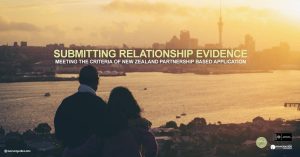
    Submitting Relationship Evidence: Meeting the Criteria of New Zealand Partnership Based Visa Application

    Background

    The process of applying for a partnership-based visa may appear to be quite transparent and straightforward. However, there are many challenges that prospective applicants face, which results in their application getting declined. To be able to unite with your partner when your partner is either a New Zealand citizen/resident or holder of a student visa, you must get familiar with the process. By doing so, you would increase the likelihood of getting your partnership based visa application approved.

    What You Need to Know About NZ Partnership Visa

    There are different types of partnership-based visas, and the category of your application is dependent upon the immigration status of your partner in New Zealand and the purpose of your visit.

    The most common types of partnership-based visa include:

    • Work/Visitor visa for a Partner of Worker
    • Work/Visitor visa for a Partner of a Student
    • Work/Visitor visa for a Partner of NZ Citizen/Resident, and
    • Residence visas for Partners of NZ Citizen/Resident

    For all relationship-based visas, the relationship between the applicant and the supporting partner must meet the definition of a “partner” as defined by Immigration New Zealand (INZ) – by way of a legal marriage or a civil union, or a de facto relationship.

    What supporting documents are required, apart from meeting the health and character requirements should be clear from the start. The documentary evidence required to be submitted to establish your relationship with the partner must be collected and collated.

    The list of acceptable evidence could vary depending on the visa type you’re applying for and the kind of relationship you share with the partner.

    It can include, but is not limited to, a Marriage Certificate, Photographs of you & your partner together, joint bank accounts, joint rental agreement, social media conversations, and many more. The type of evidence provided will assist the INZ case officer in ascertaining that you and your partner are in a genuine and stable relationship.

    Satisfactory documentary evidence is required to be submitted if you and your partner have stayed apart for a considerable period for some reason. This evidence should include – the reasons you were living apart, how long you were living apart and how you kept in touch while apart.

    Despite there being a defined process and instructions, many applicants are unsuccessful in obtaining a partnership-based visa. While there could be numerous reasons for application getting declined, the most common reason is that the visa officer assessing the application was not satisfied with the evidence that was submitted.

    The proof of the relationship provided with the application must meet the relevant immigration instructions. Providing voluminous and irrelevant documents that will not satisfy the immigration officer, and would diminish the chances of approval.

    In many instances, INZ case officer is not even obliged to request more information from an applicant and can straightaway decline the application based on the information on hand. This is where the experience and expertise of a Licensed Immigration Adviser (LIA) plays an important role. So, it is ideal to have an LIA advise you who is skilled and familiar with the partnership based visa application process.

    Get Expert Immigration Advice

    We are a highly experienced team of Licensed Immigration Advisers, who provide a range of Immigration services including partnership-based visas. We can assist you to successfully apply for and get a New Zealand visa under partnership category. Connect with us if you want assistance in the submission of relationship based application. We have been successful in getting approvals for even some of the most complex cases.

    Get in touch with us today, talk to an experienced Licensed Immigration Adviser, and get a free profile assessment done.

    Successful Ministerial Intervention Appeal: Partnership Based Visa Application

    Background

    Raman Singh (name changed) first arrived in New Zealand from India on a student visa in 2017. After two years, he became friends with Karen (name changed). Karen is a New Zealand citizen but originally from the Pacific islands.

    As time passed, the friendship turned into a relationship. Raman and Karen enjoyed each other’s company and begun seeing their future together. They soon decided to move in together to spend more time with each other. The relationship became strong with time. The couple enjoyed every moment of the time spent together. The living together in due course resulted in Karen becoming pregnant. Karen soon gave birth to Raman Singh’s child.

    Partnership Visa Declined By Immigration New Zealand

    As Raman’s open work visa was about to expire, he decided to lodge a partnership-based work visa with Immigration New Zealand (INZ). INZ took a long time to process and give a decision on the application. Unfortunately, INZ decided to decline their partnership based visa application. The decision of INZ to reject the visa application was based on a telephonic interview. This telephonic interview was conducted with Raman’s parents, who were based in India.

    Introduction With Immigration Advisers New Zealand Ltd

    When Raman and Karen came to our Auckland office, they met Vandana Rai, Senior Licensed Immigration Adviser. Vandana met them and realised that they were distraught with despair. To them all seemed lost and they feared for their childs future.

    Vandana Rai and her team of Licensed Immigration Advisers carefully reviewed the INZ decline letter. The next step they decided to take was to request for the client file notes from INZ under the Official Information Act (OIA). When the client notes arrived from INZ, some flaws and shortcomings in the assessment process during the assessment of the visa application were noted.

    Approach Taken To Submit Section 61 Request

    As part of the process, a Section 61 request was submitted. In the submision all the details of the couple’s genuine and stable relationship were provided. The advocacy submitted as part of Section 61 Request highlighted the flaws in the assessment process. Unfortunately, INZ decided to decline the Section 61 Request too.

    The intercultural relationships between a temporary visa holder, and a New Zealand resident/citizen are still looked at with a lot of suspicion by INZ. At times they may even overlook the compelling documentary evidence provided to prove the genuineness of the relationship. In this case, the couple had provided sufficient evidence to demonstrate that they were in a genuine and stable relationship. However, it was disappointing to see the application still being declined. Raman lost all hope and started thinking about going back to India. It was his newborn child who gave him strength, and he decided to approach Vandana Rai for the Ministerial Appeal.

    Successful Ministerial Intervention

    Vandana Rai and her team were determined to help the client and decided to seek Ministerial Intervention in this matter. The team prepared detailed submissions and sent the same to the Minister of Immigration. Vandana Rai ensured that the advocacy was meticulous, well supported and explained all available information supported by documentation. The well prepared submission was then made to the Minister’s office. After reviewing the submissions, the Minister decided to grant an open work visa under Section 61 to Raman Singh.

    Conclusion

    The positive outcome of this Ministerial Appeal highlights the importance of strong advocacy which comes with knowledge ,competence and experience. INZ sometimes may not act as per the principles of fairness, and natural justice and the process can take its toll on applicants.

    This is where the skills and expertise and character of an experienced licensed immigration adviser play a vital role. In this instance, Vandana Rai did not give up on her client and persevered in trying all possible avenues in helping her client obtain a visa.

    The couple is happy to have finally been able to obtain a New Zealand work visa for Raman Singh. Karen is glad and relieved that the family can continue to stay together in New Zealand. A partnership based residence visa application for Raman is currently under process and is progressing well.

    New Zealand Partnership – Based Visa: What You Need to Know Before Applying

    The process of applying for partnership-based visas may appear to be simple and transparent, however, there are challenges that people face, which results in their application getting declined.

    So, if your partner is a New Zealand visa holder or a New Zealand citizen/resident, and you would like to join them, you must get conversant with the process before you apply for the partnership-based visa. It will enhance your chances of getting your application approved.

    What You Need to Know About NZ Partnership Visa

    There are different types of partnership-based visas. It depends on the immigration status of your partner, as well as the purpose of your visit.

    The most common types of partnership-based visa include:

    • Work/visitor visa for a partner of worker
    • Work/visitor visa for a partner of a student
    • Work/visitor visa for a partner of NZ citizen/resident, and
    • Residence visas for partners of NZ citizen/resident

    For all categories of partnership-based visas, the relationship with the supporting partner must meet the definition of a partner as defined by the immigration instructions by way of a legal marriage or a civil union, or a de facto relationship (when a couple lives together but isn’t married or in a civil union).

    The Documents Needed

    Supporting documentary evidence is needed to establish your relationship with the partner.

    The list of acceptable evidence could vary depending on the visa type you’re applying for and the kind of relationship you share with the partner. It can include marriage certificates, photos together, joint bank accounts, joint rental agreement, social media conversations, and many more.

    The type of evidence provided will help the case officer ascertain that you live with your partner in the same home – and are in a genuine and stable relationship.

    In case, you and your partner have stayed apart for whatever reason, adequate information must be provided regarding the same, which will be assessed before proceeding with the application.

    The Additional Requirements

    Apart from providing documents and (credible) evidence, there are also a host of things that you must have prior knowledge of. It is to ensure smooth and hassle-free assessment and prompt decision on the application. Here are some of those additional requirements :

    • You must meet the character requirements for the visa as listed by Immigration New Zealand (INZ)
    • You must meet health requirements.
    • You must meet the definition of a “partner”.
    • You must meet the relevant requirements for the visa category you are applying for.

    Of course, there are many other document requirements for a partnership-based visa that you must be aware of.

    The Challenges

    Even with a defined process and basic instructions published, many people do get their application for partnership-based visas declined. There are many reasons why. It primarily depends on what kind of evidence they provided – and how the Immigration Officer interpreted them.

    So, it’s an ideal choice to consult experts like Immigration Advisers New Zealand Ltd and get more acquainted with the application process. This is to equip yourself with details that go beyond basics.

    For this very purpose, we have planned to present a webinar on “partnership-based Visa: New Zealand – How to make a successful application?”

    The webinar session will have licensed (and experienced) experts who will cover a range of topics on the subject, including:

    • Assessment criteria of a partnership-based application
    • Are people with complex partnership cases eligible for the visa?
    • How does culture/nationality impact a partnership-based application?
    • What are the common reasons why the application is declined?
    • Can you re-apply after your application for a partnership-based visa has been declined?
    • What are the best practices to re-apply after being previously declined?
    • What is a culturally-arranged marriage and if that partner can apply for this visa?
    • What if the duration of living together as a couple is less?

    And more…

    About Immigration Advisers New Zealand Ltd.

    Immigration Advisers New Zealand Ltd. is one of the most reputed names in the New Zealand immigration industry. We offer end-to-end immigration services, ensuring complete assistance to people with their New Zealand visa needs.

    Scheduled for 29th May 2020 (Friday), our live session is for people who are looking to apply for a New Zealand partnership-based Visa. It will have experts addressing various topics and common queries that people have regarding the partnership-based visa application.

    So, if you’re planning to apply for a New Zealand partnership-based Visa, attend the session to find insights, tips, and assistance that will maximise the chances of your application approval.

    Register For the Live Session

    Topic: Partnership-Based Visa: New Zealand – How to make a successful application

    When: 29th May 2020 (Friday)

    Time: 5:00 pm NZT

    Host: Vandana Rai

    Panellists: Himanshu Rai, Vineet Bhardwaj, and Manmeet Singh Grover
    (All the four speakers are licensed immigration advisers who have extensive experience of working with hundreds of couples and helping them with their New Zealand visa requirements.)

    Who should register: People – engaged, married, or in a relationship and want to know more about New Zealand Partnership Visa.

    How to register: https://zfrmz.com/bCUXdP8FqkFmaFBlgoiI

    For more information, please get in touch with us.