Provide All Relevant Information - Submit Query

Student Visa

Profile Check Form

Click Here ×
S
t
u
d
e
n
t

V
i
s
a

Get in Touch

    New Zealand Opening Borders in 2022 – Stages and Dates Confirmed!

    And finally, some good news for people who have been waiting tirelessly to visit New Zealand! New Zealand (NZ) borders are set to open from January 2022 to New Zealanders and for the other countries from April 2022.

    This announcement gives certainty and a glimmer of hope to so many families, businesses, visitors, airlines, and airport companies that New Zealand is returning to a phase of normalcy.

    The New Zealand Government has made an announcement that:

    • Fully vaccinated Kiwis and other eligible travellers can travel to NZ from Australia without staying in MIQ from 11.59 pm Sunday, 16 January 2022
    • Fully vaccinated Kiwis and other eligible travellers can travel to NZ from all other countries from 11.59 pm Sunday, 13 February 2022
    • All fully vaccinated individuals will be able to travel to NZ from 30 April 2022 onwards, with the re-opening staged over time
    • The Very High-Risk classification for Indonesia, Fiji, India, Pakistan, and Brazil will be removed early next month.

    The border will open in three stages, and all travellers who are not needed to enter MIQ will still be required to do:

    • a negative pre-departure test
    • proof of being fully vaccinated
    • a passenger declaration about travel history
    • a day 0/1 test on arrival
    • a requirement to self-isolate for seven days, and
    • a final negative test before entering the community

    Information on when visitors can enter New Zealand without going through MIQ:

    Step 1:

    From 11.59 p.m. on January 16, 2022, fully vaccinated New Zealand nationals, individuals with a residence-class visa, and other visitors qualifying under our present rules from Australia will be able to travel (provided they have been in Australia or New Zealand for the past 14 days).

    Step 2:

    From 11.59 pm Sunday 13 February, fully vaccinated New Zealand citizens, residence-class visa holders, and other travellers eligible under our present border settings, save from Very High-Risk nations, will be able to enter the country.

    Step 3:

    From 30 April onwards, open to fully vaccinated foreign nationals (perhaps staged by visa category).

    Those who do not meet the criteria for the above 3-Steps will still be allowed to enter New Zealand under present border conditions will be placed in MIQ immediately upon arrival, where they will spend seven days in controlled isolation followed by three days at home.

    With so many new announcements coming out, it is important to be abreast with these and it can get a bit overwhelming, which is why our team of skilful and proficient Licensed Immigration Advisers are here to provide assistance to you.

    Get in touch with us at Immigration Advisers New Zealand Ltd., which provides up-to-date immigration information so you can consider opportunities and prepare yourself for the future. To know all the required processes and information contact us at:

    Email:contact@nzimmigration.info

    Call: +64 09 3790219.
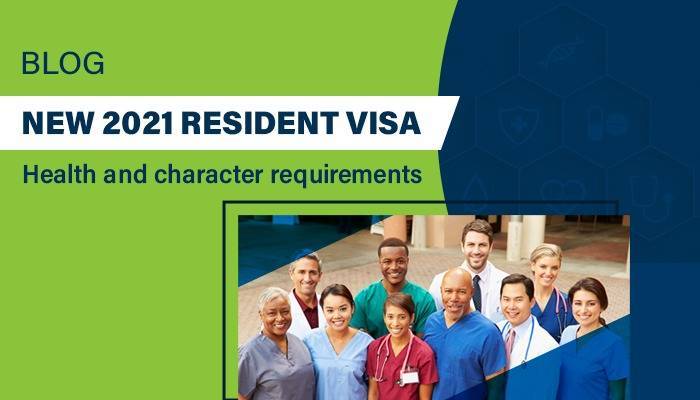
    Health And Character Requirements For The New 2021 Resident Visa

    The New Zealand Government had announced on 30th September 2021 the New 2021 Resident Visa, a one-time, simpler pathway to residency for migrants in New Zealand. The immigration instructions about the 2021 Resident Visa include the Health and Character requirements under this visa category.

    These immigration instructions issued vide Amendment Circular No. 2021-48 will be effective from 1st December 2021.

    Health Requirements

    An applicant for the new 2021 Resident Visa will need to provide a Limited Medical Certificate (INZ 1007). Please note that the health requirement may be limited but will capture conditions that are not eligible for medical waivers (tuberculosis, haemophilia, and conditions requiring dialysis or full-time care).

    Important points to note are as under:
    • medical certificate is not required to be submitted to Immigration New Zealand (INZ) if you have submitted it in the last 36 months and were clear.
    • medical certificate may be requested by INZ or the immigration officer assessing your application if:
      • your previous medicals were not clear; or
      • your previous medicals were clear but with conditions; or
      • you have spent six consecutive months outside of New Zealand; or
      • INZ thinks they must establish that you have met the medical requirements
    • chest x-ray certificate (CXR) might be requested by INZ or the immigration officer assessing your application if you had earlier not submitted the CXR because of your age or pregnancy.
    • INZ may grant a medical waiver to a partner or dependent of a New Resident or Citizen if all the immigration instructions for the said visa category are met.

    Character Requirements

    INZ will undertake New Zealand Police checks for all 2021 Resident Visa applicants aged 17 years or older, regardless of how long they have been in New Zealand. INZ will also undertake National Security Checks (NSC) for all applicants who would normally require one as part of standard immigration processes and requirements.

    INZ may also request more information or verification needed as part of the process. Important point (s) to note is if you are 17 years and above when applying for the new 2021 Resident Visa:

    • you are not required to submit a Police Clearance Certificate (PCC) from your country of residence; and
    • you are not required to submit PCC from any country in which you have lived for 12 months or more in the last 10 years

    It is vital to remember, regardless of all of the above, INZ or the immigration officer assessing your application may still request for the medical certificate and/or PCC if they think it is necessary for them to establish that you meet the health and/or character requirements of the 2021 Resident Visa immigration instructions.

    Please do not hesitate to contact Immigration Advisers New Zealand Ltd. if you have any queries or require assistance regarding the above information. Our experienced team of Licensed Immigration Advisers will be happy to guide you.

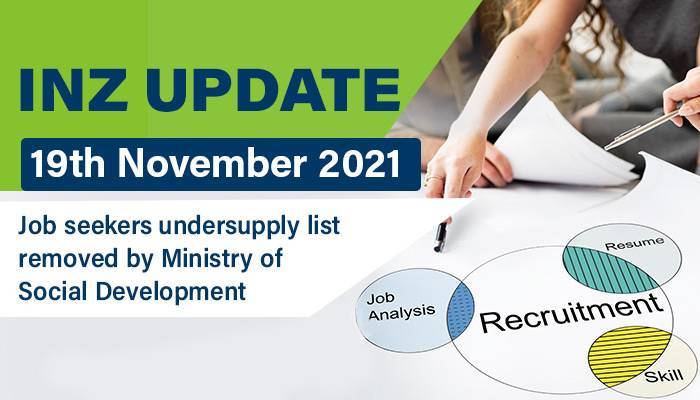
    Ministry of Social Development: Job Seeker Undersupply List Removed

    In response to COVID-19, a temporary solution was introduced by the Ministry of Social Development (MSD) – the jobseeker oversupply and undersupply lists. MSD launched these lists in October 2020 to streamline MSD’s advice to Immigration New Zealand (INZ) on the availability of New Zealand job seekers for jobs. The occupations on the oversupply list indicated that there were New Zealand job seekers available for that position.

    There were no New Zealand job seekers available in the occupations on the undersupply list.

    With effect from 22nd November 2021, the MSD has removed the job seeker undersupply list. The oversupply list was withdrawn on 1st October 2021, as previously announced.

    This advice is part of the Labour Market Test (LMT) for employment paid below the median wage when applying for an Essential Skills work visa.

    What does it mean to have the job seeker undersupply list removed?

    Employers will need to interact with MSD to assess whether suitable or trainable New Zealand job seekers are available. The objective will be to fill vacancies for roles that pay less than the median wage and require labour market testing now that the undersupply list has been removed.

    For roles that were previously on the undersupply list, employers will now need to publish the vacancy with MSD to acquire a Skills Match Report (SMR). The SMR will advise on the availability of New Zealand job seekers for the given position.

    When reviewing Essential Skills work visa applications for occupations paying less than the median income, INZ must consider this advice as part of the LMT. When deciding whether the LMT has been satisfied, INZ will take the employer’s overall efforts to attract and recruit New Zealanders into account. For more information on hiring migrant workers, please click here.

    Applicants whose occupations are listed on INZ’s Skills Shortage Lists, as well as those who continue in full-time employment and do not change their role, employer, or region of work, will not need an LMT.

    For information on the skill-shortage list checker, please click here.

    If you have queries or require assistance regarding the above information, please do not hesitate to contact Immigration Advisers New Zealand Ltd. at contact@nzimmigration.info or call +64 09 3790219. Our experienced team of Licensed Immigration Advisers will be happy to guide you.

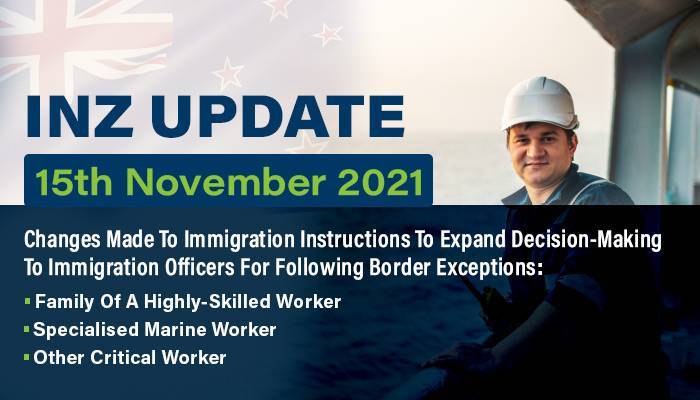
    INZ Makes New Amendments To Border Exceptions

    Immigration New Zealand (INZ) has made new amendments to the assessment of Border Exception for the following:

    • Other critical worker
    • Family of a high skilled worker
    • Specialised marine worker

    These amendments to the immigration instructions are effective from 15th November, 2021.

    The following are the summary of main changes to the immigration instructions:

    • AIP for other critical workers to travel to New Zealand.

    The employer or the supporting agency/organisation is required to make an Expression of Interest (EOI) for an Approval in Principle (AIP) to INZ through a prescribed form available on their website and pay the relevant fees for the person and their family who intend to come to New Zealand as ‘other critical worker’. This person’s partner and dependent children can be included. in the AIP too. In addition to meeting health, character and bona fide requirements worker must have funds or sponsorship and onward travel arrangements too.

    • AIP for marine crew arriving by the maritime border to travel to New Zealand

    A marine crew who has a genuine reason to travel to New Zealand, their shipping agent or employer or the owner of the ship may request for AIP by way of an EOI which is emailed to INZ and pay the prescribed fees. The AIP must include evidence that the said crew meets the definition of ‘Marine Crew’

    • Defining Other Critical Worker for the purpose

    An ‘other critical worker’ is defined as someone who is required to come to New Zealand for up to 6 months and has technical/specialist skills and unique experience; or undertakes a time-critical role; or meets requirements of approved class worker (see list here)

    A person who is determined as ‘other critical worker’ can be granted up to 12 months stay in New Zealand if they are in a work that is time-critical or the person has unique experience or technical/specialist skills and they earn twice the median salary (currently NZD $106,080 pa) among other important criteria.

    A student who has an offer of place or enrolled in Doctoral Degree with a New Zealand University can be determined as ‘other critical worker’ if they have a role that is essential to complete a science programme which government funded and has support of MBIE Science, Innovation and International Branch. In addition must also have unique experience and technical/specialist skill set not readily available in New Zealand and are undertaking a time-critical role.

    • Requirements for the temporary visa holder’s requirement

    The said worker must be earning twice the median salary (currently NZD $106,080 pa) in addition to having unique, specialised or technical skill sets not readily available in New Zealand. Other criteria can be read here.

    2021 Resident Visa Pak 488: Interim Processing Guidelines

    On 8 November Immigration New Zealand (INZ) has issued VISA PAK 488. This document outlines the interim process for Skilled Migrant Category (SMC), Residence from Work (RFW) and Work to Residence (WTR) applications that are already in process for applicants that may be eligible to apply in Phase 1 of 2021 Resident Visa.

    All applications will be assessed in accordance with the general instructions given by the Deputy Secretary at A16.1 which outline the order and manner of processing of visa applications.

    Interim Process

    SMC and RFW applications

    During the assessment stage, if an Immigration Officer identifies that an applicant may not meet the resident visa requirements under the category applied for, then the following steps will be taken:

    • the Immigration Officer will inform the applicant/ their representative about the potentially prejudicial information i.e. the concerns that have been identified, and offer the following:

    • give an opportunity to the applicant to provide further information or evidence to show that they meet the requirements under SMC and RFW and/or
    • give an opportunity to the applicant to inform INZ to put their SMC or RFW application on hold and test their eligibility for the 2021 Resident Visa category

    • the Immigration Officer must receive written consent from the applicant to put the SMC/ RFW application on hold. The Officer will then inform the applicant to submit a 2021 Resident Visa application. (a fee does not have to be paid upfront)
    • In case the applicant requests INZ to continue processing their application under the existing resident visa category, the Immigration Officer will continue with the application assessment

    WTR applications

    As per current practice, when an Immigration Officer is unable to approve the ongoing WTR application but is satisfied that the applicant can be granted a visa under another category, the officer will use his discretionary powers to do so. It is the Officer’s duty to inform the applicant that they will no longer have a residence pathway from the RFW category if granted a visa under another category. If an applicant wishes to test their eligibility for the 2021 Resident Visa, a separate application will have to be lodged for this process.

    Applicants must give written consent to INZ that they wish to be assessed under a different temporary visa category prior to doing so.

    Get in touch with Immigration Advisors New Zealand Ltd, which provides up-to-date immigration information so you can consider opportunities and prepare yourself for the future. To know all the required procedures, contact us at contact@nzimmigration.info or call on +64 09 3790219.

    2021 Resident Visa: Know All About Settled Criteria

    The announcement by the New Zealand Government of the new one-off 2021 Resident Visa on 30 September 2021 offers a seemingly easy pathway to residence. However, to be eligible, applicants must have been in New Zealand on 29 September 2021 and be on an eligible visa or have applied for one before 29 September that is subsequently granted.

    Besides the above two mandatory criteria, applicants must also meet any one of the following criteria– Settled, Skilled or Scarce. In this article, we will talk about the ‘Settled’ criterion.

    Settled Criteria – Eligibility

    The settled criterion is applicable to those who have lived in New Zealand for the past 3 years or more. However, it cannot be just any 3 years. You must also:

    • have arrived in New Zealand on or before 29 September 2018 and
    • have spent at least 75% of the 3 years (821 days) in New Zealand during the period of 29 September 2018 to 29 September 2021 (inclusive)

    The period of living in New Zealand does not have to be consecutive and there is no minimum amount within a calendar year requirement.

    Documentary Evidence Required

    To determine whether an applicant meets the settled criterion, Immigration New Zealand will use the border movement records available with them. The best part is no further evidence will be required unless requested by an Immigration Officer. It is often said that incorrect documentation is worse than no documentation. Hence, make sure that you calculate your eligibility accurately.

    Do you meet the settled criterion of the new 2021 Resident Visa? If the answer is YES, then don’t miss the chance to gain resident status in New Zealand! Get in touch with Immigration Advisors New Zealand Ltd, which provides up-to-date immigration information so you can consider opportunities and prepare yourself for the future. To know all the required procedures, contact us at contact@nzimmigration.info or call on +64 09 3790219.

    Source: Click here

    Know All About English Language Tests Accepted By INZ

    Every country and educational institute has a different language requirement for migrants. Nevertheless, language proficiency for migrants is critical since it facilitates assimilation in a foreign country and improves work prospects. Language abilities also aid social integration and academic accomplishments.

    The English language is one of the three official languages of New Zealand. The other two are the Māori language and New Zealand sign language.

    Do you want to study, work or live in NZ?

    If you want to work, study or migrate to New Zealand, you must have a certain level of proficiency in the English language.

    Immigration New Zealand (INZ) expects different English language proficiency levels for various visa categories; accordingly, the scores differ for each visa category. Whether you are the principal applicant, a partner, or a dependent child determines the proficiency level required. At the time of submission of the visa application, the English language test results must not be older than two years. It is always best to check the specific visa type you intend to apply for to see the English requirements for that specific visa by clicking on this link here.

    Student visa requirement

    INZ does not set an English language requirement for Student Visa applications. Some Education Providers (especially at the tertiary level) require a certain level of English before offering you a place, but this will vary from one provider to the next. You will have to find this out individually.

    Therefore, you should directly discuss course requirements with your education provider or their authorised representatives like Immigration Advisers New Zealand Ltd.

    Please note that as an international student, even if you have an English-speaking background, you may still have to provide an English language test result to show that you meet the minimum standard.

    English language proficiency test score is not a requirement if you study English in New Zealand.

    Acceptable English language proficiency tests

    Some of the acceptable English language proficiency tests are:

    • International English Language Testing System
    • Test of English as a Foreign Language
    • Internet-Based Test (TOEFL iBT)
    • Occupational English Test (OET) (for health
    • care professionals)
    • Cambridge Assessment English – B2 First (FCE)
    • Cambridge Assessment English – B2 First for
    • Schools (FCE for Schools)
    • Pearson Test of English Academic (PTE: Academic)

    To find out which English language tests INZ accepts and the results you need for the visa you are applying for, please click here.

    As evident, it is very important to find out the English language requirement for a particular visa category before applying for one.

    If you have any queries or require assistance regarding the above information, please do not hesitate to contact Immigration Advisers New Zealand Ltd. at contact@nzimmigration.info or call +64 09 3790219. Our experienced team of Licensed Immigration Advisers will be happy to guide you.

    References:

    Decoding The New One-Off 2021 Resident Visa Immigration Instructions

    Immigration New Zealand (INZ) has amended the immigration instructions to implement the New 2021 Resident Visa Category by issuing an Amendment Circular dated 29 October 2021.

    The instructions cover the eligibility criteria, assessment process, documentary evidence required, fees, and health and character requirements.

    The link to the detailed instructions is here.

    In this article, we have endeavoured to give you information that we feel is absolutely crucial for you to know for planning the successful lodgement of your New Resident Visa application. Details and the correct interpretation of the immigration instructions can be obtained by contacting us at conatct@nzimmigration.info

    The submission of applications will open in two phases:

    • Phase 1 will open on 1st December 2022, and
    • Phase 2 will open on 1st March 2022.

    Other important timelines are 29th September 2021, when the migrants (other than critical workers planning to arrive and apply before 31st July 2022) on eligible visas had to be in New Zealand and 31st July 2022, when this Resident visa category will close.

    Important Eligibility Information


    • The primary applicants must have been in New Zealand on 29 September 2021, and
    • have been on an eligible visa, or have an application submitted for an eligible visa on 29 September 2021 that was later granted.
    • Applicants must meet the stipulated requirements of settled, skilled or scarce at the time of application and on 29th September 2021.
    • An applicant that meets the criteria for settled, skilled or scarce must also meet the criteria for holders of an eligible Visa.
    • If you leave New Zealand after submitting your application, your residence visa will not be processed until you re-enter New Zealand. These applications would be put on hold.
    • Applicants must provide sufficient documentary evidence to demonstrate that they meet the claimed Settled, Skilled or Scarce criteria.
    • Dependent children aged 25 years and over may be eligible for a 2021 Resident visa based on eligibility criteria even if they are not in New Zealand.
    • Partners outside New Zealand can also be included in the application provided partnership visa requirements have been met in line with current residence requirements.
    • Respective applicants and their family members must meet the requirements for health and character as specified by INZ.
    • If the applicant arrives in New Zealand on a critical health worker or other critical worker visa for a long-term role after 29 September 2021 and moves to an eligible work visa before applying for the 2021 Resident Visa before 31 July 2022, they will not have to meet the settled, skilled or scarce criteria.
    • An applicant who was in Australia on 29 September 2021 and departed New Zealand for Australia between 6 April 2021 and 23 July 2021 (inclusive) is eligible to apply for this visa.

    Documentary Evidence Required


    Documentary evidence lies at the heart of any visa application, and its importance cannot be overestimated.

    • Evidence for meeting settled criteria: An immigration officer will use immigration travel records information to determine whether an applicant meets the settled criteria.
    • Evidence for meeting skilled criteria: Applicants’ current remuneration as well as their remuneration on 29 September 2021 will be considered. Evidence provided for remuneration must include an employment agreement or letter from the employer stating the pay and hours. The supporting documents could be full bank statements showing salary payment or a summary of income details from Inland Revenue or payslips. Please note, an immigration officer may request any additional evidence.
    • Evidence of meeting scarce criteria: For an applicant who holds a current work visa that specifies they may only work for a specific employer; immigration officers will consider information provided on the 2021 Resident Visa Application form and information provided with the previous work visa application
    • An applicant whose occupation has not previously been assessed or evidence was not previously provided will be required to provide an employment agreement or letter from the employer stating the occupation and hours and evidence of provisional or full registration in an occupation in New Zealand where this is required.

    Please note that an immigration officer may request any additional evidence as necessary to determine if the applicant meets (and/or met) the scarce criteria. For example, evidence may be required to demonstrate an applicant’s current occupation and the occupation they held as on 29 September 2021.

    If you have any queries or require assistance regarding the above information, please do not hesitate to contact Immigration Advisers New Zealand Ltd. at contact@nzimmigration.info or call +64 09 3790219. Our experienced team of Licensed Immigration Advisers will be happy to guide you.

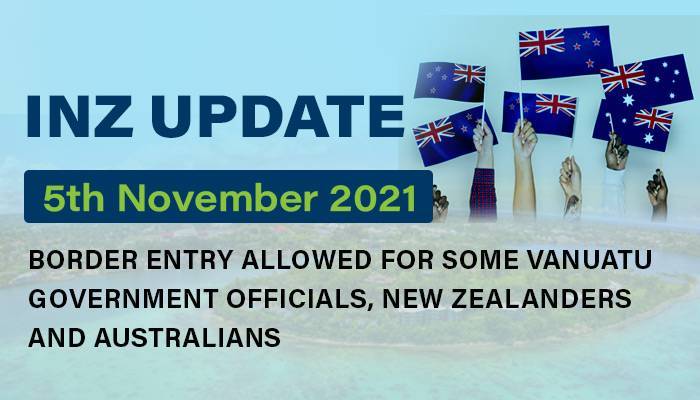
    Border Entry Allowed For Some Vanuatu Government Officials, New Zealanders And Australians

    Changes have been made to immigration instructions related to border exceptions to allow Vanuatu government officials to travel to New Zealand, where the travel is essential and officially requested by the Vanuatu government.

    Border entry instructions have also been amended to allow the entry of New Zealand resident visa holders and Australian citizens and permanent residents who are travelling to New Zealand from Samoa, Tonga, Vanuatu or Tokelau, and who meet the requirements to travel quarantine-free.

    These instructions are effective on and after 8th  November 2021.

    Another version of border entry instructions which include changes already certified relating to the 2021 Resident Visa are effective on and after 1st  December 2021.

    Please click on this link for reference.

    2021 Resident Visa: Know All About Scarce List Criteria

    The announcement by the New Zealand Government of the new one-off 2021 Resident Visa on 30 September 2021 offers a seemingly easy pathway to residence.

    However, to be eligible, applicants must have been in New Zealand on 29 September 2021.

    In addition, you should also be on an eligible visa or have applied for one before 29 September that is subsequently granted.

    Besides the above two mandatory criteria, applicants must also meet any one of the following criteria – Settled, Skilled or Scarce. In this article, we will talk about the ‘Scarce’ criterion.

    Scare List – Eligibility

    The scarce criterion is for those who have job roles on one of the scarce lists. To be eligible, an applicant must have been employed full time, on an average of at least 30 hours per week, in a role on a list of scarce occupations on 29 September 2021 and on the date on which they submit their application. In addition, the employment must be genuine and paid by salary, wages or as per the terms of the contract.

    There are four scarce lists:

    Evidence of Documents

    Providing incorrect documents is worse than providing no documents; hence, you must be fully aware of the correct documentary evidence required to submit this one off the 2021 resident Visa application. The essential documents as per the immigration instructions are:

    • an employment agreement or a letter from the employer confirming the employment & hours of work and,
    • evidence of occupational registration in New Zealand (if required)

    In addition to the above, an immigration officer may request any additional evidence as necessary to determine if you meet (and/or met) the Scarce criteria. For example, evidence may also be required to demonstrate your current occupation and the occupation you held as at 29 September 2021.

    For businesses affected by Covid-19 related instructions, there is some flexibility if work hours are temporarily reduced. INZ will consider the history of contract work and the current contract for applicants working on a contract basis.

    It may also be noted that occupations indirectly related to health services or corporate functions like human resources, office administration, property maintenance, etc., will not be considered under the scarce criterion.

    Do you meet the scarce criterion of the new 2021 Resident Visa? Then, don’t miss the chance to gain easy residency! Get in touch with Immigration Advisors New Zealand Ltd, which provides up-to-date immigration information so you can consider opportunities and prepare yourself for the future. To know all the required procedures, contact us at contact@nzimmigration.info or call on +64 09 3790219.

    NZ Approves Border Exception for 1000 International Students

    Through an announcement dated 22 October 2021, New Zealand Government has approved 1,000 international tertiary students for border exception.

    NZ expects these students to start arriving from March-2022.

    Identifying the students for entering New Zealand would commence with education providers nominating students beginning October 2021.

    Once students signal their interest in studying in New Zealand, education providers or their authorised representatives like Immigration Advisers New Zealand Ltd will contact them to discuss their eligibility for nomination.

    The border class exception will permit 400 pilot trainees, 300 students at degree level and above and a further 300 students at the sub-degree level to arrive in New Zealand. The Ministry of Education is working in collaboration with the New Zealand Government on this initiative to start bringing back international students.

    Please note that even if you are nominated, students must meet the Immigration New Zealand (INZ) Student Visa category requirements. Students will need to meet requirements like: received the full course of an approved vaccine, providing evidence of funds-NZ$ 20,000 annually for living expenses or NZ$1,667 for each month of study if the course is less than 36 weeks, providing evidence that you can pay for Managed Isolation and Quarantine (MIQ), demonstrate English language competency as per NZQA requirements etc.

    Get in touch with Immigration Advisors New Zealand Ltd, which provides up-to-date immigration information so you can consider opportunities and prepare yourself for the future. To know all the required procedures, contact us at contact@nzimmigration.info or call on +64 09 3790219.

    Source: Link 1, Link 2

    INZ Shifting To The New Accredited Employer Work Visa

    The new Accredited Employer Work Visa (AEWV) will be implemented on 4th July 2022, by the New Zealand Government.


    Please note that the applications for accreditation will open on 9th May 2022.

    Migrant workers can only be hired on the new visa, provided the employers are accredited. Businesses & regions are urged to train & upskill workers in New Zealand. Accredited employers/businesses can use the new AEWV to hire skilled migrant workers in areas where there is a legitimate need for skill or labour shortages.

    You may find out and get yourself familiarized with the new AEWV and the 3-check process here.

    In May 2021, the New Zealand Government had announced that first-time applications for the Talent (Accredited Employer) Work Visa and the Long-Term Skill Shortage List Work Visa would close on 31st October 2021. In preparation for the new AEWV, these visas are being phased out.

    Until the new AEWV is implemented, employers can continue to hire onshore temporary migrant workers on an Essential Skills Work Visa without having to obtain employer certification. The introduction of the new AEWV has no effect on other temporary work visas, such as the Recognized Seasonal Employer Limited Visa and the Working Holiday Scheme Visa.

    For more information from INZ regarding WTR visas closing to new applications please click here.

    Information for Migrant Workers on this new change:

    This new change will not affect migrants who are currently on a temporary work visa as long as they are meeting their visa conditions and their visa remains valid. If they meet the conditions under the appropriate visa category, Work to Residence (WTR) visa holders who have applied for a Residence from Work (RFW) visa may apply for a subsequent WTR visa after 31 October 2021.

    Get in touch with Immigration Advisors New Zealand Ltd, which provides up-to-date immigration information so you can consider opportunities and prepare yourself for the future. To know all the required procedures, contact us at contact@nzimmigration.info or call on +64 09 3790219.

    INZ Makes Amendment For Applicants With HIV Infection

    The Immigration New Zealand (INZ) and the Ministry of Health will no longer consider the cost of HIV (human immunodeficiency virus) treatment to be significant.

    As a result, HIV infection has been removed from the list of high-cost health conditions used to evaluate Resident Visa applications by INZ.

    The proposal to update the list was backed by PHARMAC, the National HIV and AIDS Forum, UNAIDS, and the New Zealand AIDS Foundation.

    INZ will continue to assess the medical conditions of HIV positive applicants, but will not automatically conclude that they do not have an acceptable standard of health, which could result in a visa application being denied.

    If you have any queries or require assistance regarding the above information, please do not hesitate to contact Immigration Advisers New Zealand Ltd. at contact@nzimmigration.info or call +64 09 3790219. Our experienced team of Licensed Immigration Advisers will be happy to guide you.

    INZ Introduces New Border Exceptions As Part Of Tuvalu Maritime Strengthening Project Due To Covid-19

    Immigration New Zealand (INZ) announced a new border exception to immigration instructions allowing a small number of workers from Tuvalu to enter New Zealand as part of the Tuvalu Maritime Strengthening Project.

    The Tuvalu Maritime Strengthening Project has been added to the Government-to-Government Agreement List as a result of the COVID-19, allowing the 14 crew members (as well as any required repair workers) to enter New Zealand under an ‘other critical workerborder exception.

    This exception is made under COVID-19 Support Restricted Temporary Entry requirements.

    Get in touch with Immigration Advisors New Zealand Ltd, which provides up-to-date immigration information so you can consider opportunities and prepare yourself for the future. To know all the required procedures, contact us at contact@nzimmigration.info or call on +64 09 3790219.

    INZ Extends Duration Of Working Holiday Scheme Visa Holders

    INZ announces that by way of Special Direction every person who:

    • Is in New Zealand on 1st November 2021, and
    • Holds Working Holiday Scheme or a Working Holidaymaker Extension temporary visa (Working Holiday Visa) with an expiry date between 21st December 2021 and 30th June 2022 (inclusive)

    Will be extended for a period of 6 months from the date on which they would have otherwise expired.

    This special directive is made to manage and control or mitigate the outbreak of COVID-19 or its effects. This special direction addresses the labour market’s continued consequences as a result of COVID-19 by permitting immigration settings to be more flexible so that existing migrant workers can continue to fill labour shortages while border restrictions remain in place.

    Unless withdrawn sooner, this special direction will expire on June 30, 2022.

    Get in touch with Immigration Advisors New Zealand Ltd, which provides up-to-date immigration information so you can consider opportunities and prepare yourself for the future. To know all the required procedures, contact us at contact@nzimmigration.info or call on +64 09 3790219.