Provide All Relevant Information - Submit Query

Student Visa

Profile Check Form

Click Here ×
S
t
u
d
e
n
t

V
i
s
a

Get in Touch

    New Zealand Traveller Declaration to Replace Passenger Arrival Cards from June 2023

    In the middle of 2023, New Zealand’s Government will replace the paper Passenger Arrival Card with a new Traveller Declaration. The decision to replace Travel Declaration is part of their dedication to streamlining all procedures at airports and other entry points into New Zealand for travellers.

    Customs NZ collaborates with other border enforcement agencies, like Ministry of Business, Innovation and Employment, Biosecurity New Zealand, the Ministry of Health, and the Ministry of Transport, to create a state of art border for our country. This move will help travellers move through NZ airports and improve the safety and security of New Zealand.

    The new form will give travellers more flexibility, allowing them to arrive in New Zealand faster and more easily. Moreover, the information on the declaration will provide authorities with better data on who is entering the country, helping to ensure greater security measures are in place.

    So if you’re travelling to New Zealand soon, make sure you’re aware of this new development and complete your Traveller Declaration Form accordingly.

    Reference Link

    New Zealand Pharmacist Workforce Shortages Hit Critical Levels

    In recent months, New Zealand has seen an alarming decline in pharmacists available to work in our hospitals and other healthcare facilities. With the demand for pharmaceutical services growing with each passing day, this significant shortage of personnel is now putting a strain on the entire healthcare system.

    Supermarket chain Countdown has confirmed it had closed some pharmacies indefinitely due to pharmacist shortages, and twenty more pharmacies are currently operating with reduced operating hours due to workforce shortages.

    In light of these circumstances, it’s become increasingly crucial for the Government to take action and invest in patient-centred initiatives such as improved wages and better working conditions for existing pharmacists and offering incentives for students looking to pursue pharmacy degrees. Such measures will help ensure that more skilled professionals are available to help meet patient needs on time.

    It is also crucial that steps be taken to provide further support and resources to existing pharmacists and those just entering the workforce. By doing so, we can all play our part in helping alleviate the current pharmacist shortages and create a healthier future for everyone.

    The Ministry for Business, Innovation and Employment (MBIE) said NZ employers could recruit pharmacists through the Accredited Employer Work Visa (AEWV) scheme if they wanted to. In addition, qualified pharmacists are also likely to be eligible for the Skilled Migrant Category criteria, which is expected to be updated mid-2023 by Immigration New Zealand (INZ).

    How to obtain Permanent Residence in New Zealand

    Obtaining a New Zealand permanent resident visa is a multi-step process that involves the interpretation of Immigration New Zealand’s (INZ) residence policies and determining one’s eligibility under these policies. Here is a simplified and broad overview of the process involved:

    Have an Acceptable Standard of Health and Character:

    To be eligible for a New Zealand permanent resident visa, the two primary requirements are to be of good character and have an acceptable standard of health.

    If you do not have any court cases, have never been removed or deported from another country and are not prohibited from entering another country, you are likely to be considered as being of good character as per INZ. To be considered healthy, you should not be suffering from any health condition that is likely to require significant care and/or hospitalization in New Zealand. However, the assessment of health and character may not always be straightforward. Therefore, if there is any ambiguity in your mind, the best solution would be to approach a Licensed Immigration Adviser and have an honest and open discussion with your adviser.

    Choose a Residence Category:

    Once you have ticked off health and character, the next step would be to identify the most suitable Residence Pathway. The New Zealand government has several different categories of residency in New Zealand.

    These are –

    Each category has its eligibility requirements, so choosing the category that best fits your circumstances is important. It is strongly recommended that you consult a licensed immigration adviser to guide you appropriately in determining the most suitable pathway for obtaining residence in New Zealand.

    Processing Time Frames:

    Before getting a Permanent Resident Visa, you must obtain residence in New Zealand. Processing times for residence and permanent residency applications vary, but it is generally a good idea to allow several months for a decision to be made. You will be notified by Immigration New Zealand if your application is successful or if additional information is required.

    I hope this information is helpful! If you have more questions about applying for a permanent resident visa in NZ, do not hesitate to seek advice from a licensed immigration adviser.

    Get in touch with Immigration Advisors New Zealand Ltd, which provides up-to-date immigration information so you can consider opportunities and prepare yourself for the future. To know all the required procedures, contact us at contact@nzimmigration.info or call +64 09 3790219.

    Variation of Conditions on A New Zealand Visa Label

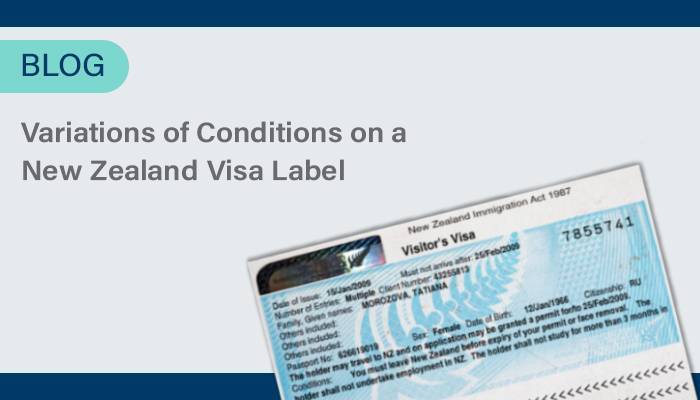
    Visa conditions, i.e. stipulations, are mentioned on the visa label when a visa is issued. These visa conditions have to be adhered to in letter and spirit. However, in some instances, Immigration New Zealand (INZ) allows a variation of these conditions after issuing a visa.

    This blog provides more information about the Variation of Conditions.

    What is the meaning of Variation of Conditions?

    If you have been issued a work, student or visitor visa and the visa conditions no longer suit you, you can apply for a Variation of Conditions.

    Temporary visas such as work, student or visitor visas have certain conditions listed on the visa that instruct the visa holder what they are allowed to do while holding the visa.

    Examples of conditions -studying a particular course, studying in a specific institute, working for a particular employer, working part-time only while studying etc.

    If there is a change in your circumstances, you can apply for a change in the visa conditions. However, you cannot apply for a Variation of Conditions in all situations. Sometimes, you may have to apply for a new visa altogether.

    Changing the conditions of a Visitor Visa

    Visitor Visas have conditions are rules related to studying, working and travelling in & out of New Zealand. Even if the conditions are changed, the visa will still expire on the same day. You can apply for a variation of conditions if you want to study part-time or want to do certain seasonal work.

    Changing the conditions of a Student Visa

    You can change the conditions of your student visa if you want to change your education provider or the location where you are studying. In some cases, you have to change your visa in order to work. Depending on certain factors, INZ may approve your change your course, education provider or location of study.

    However, if you hold a Pathway Student Visa and want to change your education provider, then you will have to apply for a brand-new Student Visa.

    Changing the conditions of a Work Visa

    Some Work Visas come with open conditions that allow you to work in any profession for any employer anywhere in New Zealand. Conversely, some Work Visas come with conditions that restrict you to working for a particular employer, in a particular role and in a particular location.

    • If you hold an Accredited Employer Work Visa (AEWV) or an Essential Skills Work Visa, you can change your employer, job, location or a combination of these.
    • If you hold a Post Study Work Visa – Employer Assisted or applied for one before 26 November 2018, you can choose to have the job, location and employer removed. This will then allow you to work for any employer.
    • If you hold a Talent Accredited Employer Work Visa, you can apply to change your job or employer.

    Do you want to change your visa conditions?

    Get in touch with Immigration Advisors New Zealand Ltd, which provides up-to-date immigration information so you can consider opportunities and prepare yourself for the future. To know all the required procedures, contact us at contact@nzimmigration.info or call on +64 09 3790219.

    Source: Link 1   Link 2    Link 3   Link 4

    New Zealand Visa: Important Immigration Requirements

    There are several requirements that must be met in order to immigrate to New Zealand. These requirements can vary depending on the specific visa category you are applying for, but there are some common requirements.

    Good character: All visa applicants must be of good character and have no criminal convictions. If you have a criminal history or could be a risk to NZ, your application can be declined by Immigration New Zealand (INZ). In some cases, you may have to apply for a Character Waiver.

    • For more information about good character and character waiver, please click here.
    • For information related to character issues, please click here.

    Health: All visa applicants must have an acceptable standard of health. Some visa categories require applicants to undergo a medical examination to ensure that they do not have any health conditions that could pose a risk to the New Zealand public or impose significant costs on New Zealand’s health services. Medical reviews in the visa process can cause substantial processing delays. Immigration Advisers New Zealand has successfully obtained medical waivers from “standard” health-related issues to exceptionally complicated health issues where significant funding will be required. If issues are encountered with the processing of an application and/or a medical waiver is required, don’t hesitate to get in touch with us without delay.

    English language proficiency: Some visa categories require applicants to demonstrate a certain level of English language proficiency. This may involve taking an English language test (e.g. IELTS, OET etc.) or providing evidence of previous English language study.

    • To know about the English language requirement to study, work & live in New Zealand, please click here.
    • To learn about the English language tests accepted by Immigration New Zealand (INZ), please click here

    Age: Some visa categories have age limits or may have different requirements for applicants depending on their age.

    Financial requirements: Some visa categories have financial requirements that applicants must meet in order to be eligible. This means you must have enough money to live on while in New Zealand or have an acceptable sponsor. For further details please click on this link here.

    Employment: Some visa categories require applicants to have a job offer from a New Zealand employer or to demonstrate that they have the skills and experience to find employment in New Zealand.

    If you do not meet any of the requirements of the specific visa category you have applied for, INZ may decline your application.

    Get in touch with Immigration Advisors New Zealand Ltd, which provides up-to-date immigration information so you can consider opportunities and prepare yourself for the future. To know all the required procedures, contact us at contact@nzimmigration.info  or call on +64 09 3790219.

    Reasons for Studying in New Zealand

    Are you thinking about studying in New Zealand? New Zealand is known for its stunning landscapes, friendly people, high-quality education and good work-life balance.

    New Zealand’s education system is ranked highly on a global scale. The country has eight universities which offer a wide range of undergraduate and postgraduate programs in various fields. Additionally, there are many polytechnics and institutes of technology that provide vocational training and applied degrees. So whether you’re interested in science, technology, engineering, or the humanities, you’ll be able to find a program that fits your interests and goals.

    One of the benefits of studying in New Zealand is the country’s focus on practical, hands-on learning. Many programs include internships or work placements, which can help students gain real-world experience and make connections in their chosen field.

    New Zealand is also a great place to learn English. The country has a high-quality education system, and many schools and universities offer English language programs. This is especially helpful for international students who want to improve their English skills before starting a degree program.

    Another reason to study in New Zealand is the high quality of education. The country’s education system is ranked highly on a global scale, and its universities offer a wide range of programs in various fields. So whether you’re interested in science, technology, engineering, or the humanities, you’ll be able to find a program that fits your interests and goals.

    One of the best things about studying in New Zealand is the country’s unique culture. New Zealand is a melting pot of different cultures, with a strong Maori heritage and influences from Europe, Asia, and the Pacific. This diverse culture is reflected in the country’s art, music, and food, providing students with a unique experience.

    In terms of cost, studying in New Zealand is generally less expensive than studying in other English-speaking countries, such as the United States or the United Kingdom. However, the cost of living in New Zealand can be moderately higher than in some other countries, so it’s essential to budget carefully.

    One of the most significant benefits of studying in New Zealand is the country’s natural beauty. New Zealand is a nature lover’s paradise from its stunning beaches and mountains to its lush forests and stunning lakes. This natural beauty provides an excellent backdrop for studying and offers opportunities for outdoor activities and adventures.

    Finally, studying in New Zealand can be an excellent opportunity for personal growth. The country’s inclusive and welcoming culture will allow you to make new friends and connections, and the experience of living and studying in a foreign country can help you develop independence and self-reliance.

    Overall, studying in New Zealand can be a fantastic opportunity for anyone looking to learn more about the world and expand their horizons. Whether you’re interested in the country’s unique culture, high-quality education, or beautiful natural surroundings, you’ll find plenty of reasons to consider studying in New Zealand.

    Summary of Important INZ Updates in 2022

    2022 has been a year of multiple immigration updates and announcements.

    The opening of New Zealand’s borders in a phased manner brought back the tourists, students, migrant workers, their partners, and dependent children who had been waiting patiently to enter the country.

    The major highlights include the New 2021 Resident Visa, Accredited Employer Work Visa, Green List of Occupations, Post Study Work Visa changes,Parent Resident Visa, and re-opening of the Skilled Migrant Category. There has also been an increased focus on bringing and retaining skilled immigrants who can contribute to the society and economy of the country. With these updates, Immigration New Zealand continues its commitment to open borders and promote cultural exchange while encouraging economic growth.

    Here are the main highlights:

    2021 Resident Visa

    The second phase of this one-off resident visa opened in March 2022. The 2021 Resident Visa closed at the end of July 2022. This visa category was divided into three criteria – settled, skilled & scarce. It enabled many migrants in New Zealand to get quick residence.

    Accredited Employer Work Visa (AEWV)

    The AEWV came into force in July 2022 replacing six temporary work visa categories. One of the most popular work visa categories – the Essential Skills Work Visa was also phased out. The AEWV made it mandatory for New Zealand employers to get accredited if they want to hire migrant workers.

    Green List

    In September 2022, Immigration New Zealand announced the Green List which is a list of highly skilled occupations that are in short supply in New Zealand and that lead to quick residence pathways. The three new residence categories are Straight to Residence, Work to Residence and Highly Paid.

    In December 2022, registered nurses, midwives and specialist doctors were added to the list.

    Post Study Work Visa Updates

    Changes to the Post Study Work Visa rights were announced in September 2022. Unlike before when the applicants could work for any employer and in any role, the Post Study Work Visa now depends on the qualification studied and the time spent studying in New Zealand.

    Furthermore, the NZ government has also announced granting of a 12-month open work visa to those applicants who held a Post Study Work Visa but were unable to enter New Zealand due to closed borders.

    Parent Resident Visa

    IN October 2022, the Parent Resident Visa category was reopened with a lower income threshold for sponsors.

    Skilled Migrant Category

    The Skilled Migrant Category Resident Visa was reopened after a long hiatus in November 2022. The threshold was set at 160 points. The next draw will be in January 2023, and the points threshold has been increased to 180.

    Critical Purpose Visitor Visa Update

    From 15 December 2022, Critical Purpose Visitor Visa holders who want to remain in their current roles are being allowed to apply for 12-month validity Specific Purpose Work Visa.

    2022 has truly been an eventful year for Immigration New Zealand (INZ) and applicants.

    Get in touch with Immigration Advisors New Zealand Ltd, which provides up-to-date immigration information so you can consider opportunities and prepare yourself for the future. To know all the required procedures, contact us at contact@nzimmigration.info or call on +64 09 3790219.

    Make the Most of Your Investment with the Active Investor Plus Visa Program

    The Active Investor Plus Visa (AIPV) Program is an excellent option for those looking to live, work and invest in New Zealand. It allows experienced high-value investors from around the world to gain entry into New Zealand and make long-term investments here. Let’s take a closer look at what AIPV offers and how it can help you make the most of your investment.

    Eligibility Requirements

    The AIPV Program requires that applicants have experience in business or investment activities. Additionally, you must invest NZD 15 million or the weighted equivalent in acceptable investments in New Zealand. The investments could be in New Zealand businesses, government bonds, and residential property. Applicants must also demonstrate that they can sustain themselves financially during their stay in New Zealand without relying on social assistance or employment opportunities. If your visa application gets Approval in Principle (AIP), you will have six months to transfer and invest your funds in New Zealand.

    The acceptable investment is determined at the time the investment is made and must continue to meet the requirements of an acceptable investment during the 48-month investment period.

    Benefits of AIPV

    The AIPV Program offers several benefits for those who qualify for it. First, successful applicants receive a three-year visa that allows them to live and work in New Zealand and travel freely throughout the country. They may also be eligible for permanent residency after five years of living and investing in New Zealand. Other incentives include access to discounted tax rates, low-interest loans from financial institutions, and more flexible immigration policies for family members. You can also include your partner and dependent children aged 24 and under in your visa application

    What’s more, this program is designed to provide investors with an opportunity to live and work in New Zealand and encourage them to become involved in the local economy through their investments. This means that when investors decide to move on from their investments, they will leave behind something of value—a boost to the local economy that will benefit everyone involved.

    Conclusion:

    For those looking to make long-term investments in New Zealand while enjoying all the benefits of living there without having to worry about immigration issues or finding employment opportunities, then the Active Investor Plus Visa Program is an excellent option worth considering. With its generous benefits and incentives tailored specifically towards high-value investors, this program provides an ideal way for skilled and experienced investors from around the world to gain entry into New Zealand and make positive contributions to its economy through their investments over time.

    Eager to know more about the process? Contact Immigration Advisers New Zealand Ltd. at contact@nzimmigration.info or call on +64 09 3790219 to get all the required information. Our experienced team of Licensed Immigration Advisers will be happy to guide you.

    Investing in New Zealand with the Active Investor Plus Visa

    The Active Investor Plus Visa is a great option for experienced and high-value investors looking to invest in New Zealand. This visa allows investors to establish a business or investment in New Zealand and provides them with the necessary support and guidance needed to do so. In this blog, we will explain what the Active Investor Plus Visa entails and why it is an attractive option for those looking to invest in New Zealand. Please note that you must have at least NZD $15 million or the weighted equivalent in available assets or funds.

    What Does the Active Investor Plus Visa Entail?

    New Zealand welcomes experienced, high-value investors to help build globally successful Kiwi businesses. You can settle or spend considerable time here, enjoying all our beautiful country offers.

    The visa requires the investor to:

    • invest a total of between NZ$5 million and NZ$15 million (depending on a weighting system that incentivises more ‘active’ investments).
    • invest across three years and maintain the investment for a further fourth year.
    • spend 117 days in New Zealand across the four-year conditional visa period.
    • and have a reasonable command of English to at least Level 5 of the International English Language Testing System.

    Why Should I Invest in New Zealand?

    New Zealand offers many advantages to foreign investors looking to set up shop there. For starters, New Zealand has one of the most stable political systems in the world and boasts low crime rates across all its major cities. It also has excellent infrastructure facilities; its well-developed road networks make it easy to travel between cities, while its telecommunications infrastructure facilitates communication quickly and easily. Furthermore, New Zealand has some of the best educational institutions in the world, making it an ideal place for businesses seeking talented people with top qualifications. Additionally, its geographical location makes it an ideal destination for companies seeking access to Asian and European markets without incurring prohibitive transportation costs.

    Conclusion:

    For skilled and experienced high-value investors looking to invest in New Zealand, the Active Investor Plus Visa is a great choice. It offers numerous advantages, such as allowing applicants who meet specific criteria to apply for residence status and granting them access to one of the most stable political systems and some of the best educational institutions worldwide. With its excellent infrastructure facilities, low crime rates across major cities, and convenient geographical location near both Asian and European markets—New Zealand is an attractive destination indeed! Furthermore, with this visa, you’ll receive all the necessary support you need throughout your investing journey—from the start till the finish! Investing in New Zealand has never been easier!

    Eager to know more about the process? Contact Immigration Advisers New Zealand Ltd. at contact@nzimmigration.info or call on +64 09 3790219 to get all the required information. Our experienced team of Licensed Immigration Advisers will be happy to guide you.

    Introducing the Active Investor Plus Visa

    Are you a high-value investor looking to make an impact in New Zealand? The Active Investor Plus Visa can help you achieve your goals. This visa allows experienced, skilled investors to contribute to the growth of the country’s economy. This blog post will discuss the Active Investor Plus Visa and how it can benefit you.

    What is an Active Investor Plus Visa?

    The Active Investor Plus Visa is a program created by Immigration New Zealand for experienced, high-value investors who want to contribute to the growth of New Zealand’s economy.

    This visa requires eligible applicants to invest NZD 15 million over three years in one or more approved investments such as business, research and development, innovation or property. It also requires that at least 25 per cent of these investments be invested within 12 months of approval.

    Benefits of Applying for an Active Investor Plus Visa

    The benefits of applying for an Active Investor Plus Visa include gaining permanent residence in New Zealand and having access to world-class educational institutions and a wide range of lifestyle opportunities. Additionally, applicants will gain access to various financial services, such as banking and investment advice, allowing them to make sound investment decisions. Furthermore, they will have access to talented staff who can provide guidance on business management and other areas related to their investments.

    Acceptable investment classes

    The Active Investor Plus visa offers four different investment options and provides greater flexibility by allowing investors to invest across a combination.

    • Direct investments allow investors to connect with and directly impact New Zealand businesses. Direct investments receive the highest weighting, with every $1 invested counting as $3 towards their visa conditions (3x). For example, an investor could meet the required investment amount by investing NZ$5m into direct investments (3 x NZ$5m = NZ$15m).
    • Invest in one of New Zealand’s innovative managed funds, e.g. private equity and venture capital. Every $1 an investor invests into managed funds counts as $2 towards their visa conditions (2x). For example, an investor could meet the required investment amount by investing NZ$7.5m into managed funds (2 x NZ$7.5m = NZ$15m).
    • Invest in New Zealand-listed equities, such as shares on the New Zealand Stock Exchange (NZX). No weighting is applied to this investment option (1x).
    • Build a better future for New Zealand through philanthropy. No weighting is applied to this investment option (1x).

    Listed equities and philanthropy are capped at a maximum investment of 50% of the total NZ$15m requirement. For example, an investor could meet the required investment amount by investing NZ$7.5m into listed equities and NZ$7.5m into eligible philanthropic causes.

    You can apply for permanent residence after four years of keeping your funds in New Zealand. If INZ approves your application in principle, you will have six months to transfer and invest your funds in New Zealand. If your partner wants to accompany you, they must apply for a visitor visa. Your dependent children can apply for student visas.

    Why Choose Immigration Advisers NZ?

    Immigration Advisers NZ have extensive experience in helping businesses with their immigration needs. We understand precisely what it takes for your application for an active investor plus visa to be successful and ensure that all requirements are met before submitting your application. Our team will work closely with you every step of the way and advise on different strategies that could accelerate your application process time frame. We also provide through our associates business support services, including tax filing advice and financial reporting guidance, so your business runs smoothly after obtaining your visa status.

    Conclusion:

    The Active Investor Plus Visa is perfect for those looking to invest in New Zealand while gaining permanent residence status. Immigration New Zealand understands that skilled investors are crucial for driving economic prosperity and has created this program specifically designed with them in mind. With Immigration Advisers NZs expertise on hand throughout the application process, you can rest assured knowing everything is being done correctly when applying for this visa category. With our help, you can start making lasting contributions towards growing New Zealand’s economy sooner than later!

    Eager to know more about the process? Contact Immigration Advisers New Zealand Ltd. at contact@nzimmigration.info or call on +64 09 3790219 to get all the required information. Our experienced team of Licensed Immigration Advisers will be happy to guide you.

    Prioritizing 2021 Resident Visa Applications of Green List Medical Professionals

    Immigration New Zealand (INZ) has announced that it will prioritize the processing 2021 Resident Visa (2021RV) for medical professionals featuring in the Green List. This is to meet the high demand for various skilled roles in the health sector.

    • Priority will be given to those Green List medical professionals who applied under the ‘Skilled’ and ‘Scarce’ streams of the 2021RV when the application reaches the ‘under assessment’ stage.
    • Priority will also be given to Green List medical professionals who applied for the 2021RV under the ‘Settled’ stream.

    For information regarding requesting prioritisation, please click here.

    Get in touch with Immigration Advisors New Zealand Ltd, which provides up-to-date immigration information so you can consider opportunities and prepare yourself for the future. To know all the required procedures, contact us at contact@nzimmigration.info or call on +64 09 3790219.
    New Government Measures for Attracting Highly Skilled Migrants

    The following measures have been implemented by the New Zealand Government to attract more high skilled migrants to New Zealand:

    1. Additions to the Green List

    Migrants overseas or in New Zealand eligible for Straight to Residence (StR) Green List roles will be able to apply for New Zealand residence.

    Migrant workers employed in Work to Residence (WtR) Green List roles can apply for residence after 2 years.

    ANZSCO code to be used by employers & applicants for a job check or Accredited Employer Work Visa (AEWV) is Specialist Physicians nec (253399).

    From 15 December 2022

    • Medical doctor roles not already on the StR Green List will be added.
    • All registered nurse & midwife roles will move from WtR to the StR Green List.

    From March 2023

    • Auditors will be added to the StR Green list
    • Those primary & secondary school teacher roles not already on the WtR Green List will be included.
    • The following roles will be added to the WtR Green List:

    Halal Slaughterer, Skilled Motor Mechanic, Skilled Telecommunications Technician, Gasfitter, Drainlayer, Building Associate (specifically Civil Construction Supervisor), Skilled Crane Operator, Earthmoving Plant Operator (General), Backhoe Operator, Bulldozer Operator, Excavator Operator, Grader Operator and Loader Operator

    • Bus and truck drivers will have a residence pathway through a sector agreement

    The Government will review the Green List in mid-2023. For more information about Green List roles, please click here.

    2. Employer Accreditation

    A 12-month extension has been granted to employers who have applied or will apply for employer accreditation before 4 July 2023

    As per the announcement made by the Government in May 2022, employers wanting to hire migrants, including those with open work rights such as students or working holiday makers, would need to be accredited by 2023. The requirement to be accredited has been deferred to 2024. This is to give the employers more time to prepare.

    3. Post Study Work Visas

    The Government has decided to grant 12-month open work visas to those applicants who held a Post Study Work Visa but were unable to enter New Zealand or had to leave the country early because of the border closure in March 2020 due to the Covid 19 pandemic.

    Family

    Family members of these Post Study Work Visa holders can apply for relationship-based visas – open work visas for partners/ spouse and visitor visa or student visa for children. Dependent children granted a student visa will pay the domestic study fees.

    Immigration New Zealand (INZ) will contact the eligible applicants in 2023

    4. Critical workers who want to remain in their current role

    From 15 December 2022, Critical Purpose Visitor Visa (CPVV) who want to remain in their current role after the expiry of their visa will be able to apply for a Specific Purpose Work Visa (SPWV).

    This way, the critical workers will have full 3 years work experience that they would have under the Accredited Employer Work Visa or Essential Skills Work Visa before a labour market test is done.

    How to apply for a SPWV:

    The SPWV application process for CPVV holders will be streamlined. The CPVV holder must meet the following requirements to be eligible for a SPWV:

    • not be deep water fishing crew, deep sea fishing crew or a seafarer worker
    • must have held a 12-month CPVV as a critical worker
    • be paid at least the minimum wage
    • meet the standard health & character requirements and
    • provide a letter from their employer confirming that the migrant worker will remain in the same role with the same or better conditions.

    Employers do not have to be accredited but must comply with New Zealand employment & immigration laws.

    For more information about how to apply for a Specific Purpose Work Visa, please click here.

    Specific Purpose Work Visa Information:

    1. The SPWV will give critical workers the right to remain in their current role for up to 3 years from the start date of their CPVV
    2. The fee for SPWV applicants is NZ $735

    Family

    Family members of these SPWV holders can apply for relationship-based visas.

    Partners/spouses can apply for open work visas.

    Please get in touch with us for more information about Partner of a Worker-Work Visa.

    Children can apply for visitor visas or student visas. School-aged dependent children granted a student visa will pay the domestic study fees.

    Get in touch with Immigration Advisors New Zealand Ltd, which provides up-to-date immigration information so you can consider opportunities and prepare yourself for the future. To know all the required procedures, contact us at contact@nzimmigration.info or call on +64 09 3790219.
    AEWV – Can Employment Details be Different from the One Approved in Job Check?

    What is a Job Check

    A Job Check is the second step in the Accredited Employer Work Visa process. This step is done to ensure that no suitable New Zealanders are available or trainable to do the job advertised before it is offered to someone overseas and to support local employment opportunities.

    If employment details are slightly different from the approved Job Check

    A frequently asked question to us by New Zealand employers and migrant employees is, ‘What happens if the employment details are similar or more favourable but not the same as those approved in the Job Check?’ For example, what is the remuneration range is slightly higher than proposed?

    The uncertainty arises because, according to immigration instructions, the employment offered must be the same as those approved in the job check by Immigration New Zealand (INZ). For remuneration, this must be within the range approved at the job check. However, INZ will consider all of the circumstances of the application during the assessment.

    The job description, which is part of the employment agreement, must also be cross-checked with the one approved as part of the Job Check. You must also confirm details of your relevant qualification if required for your job and specified by your employer in the job check.

    Get in touch with Immigration Advisors New Zealand Ltd, which provides up-to-date immigration information so you can consider opportunities and prepare yourself for the future. To know all the required procedures, contact us at contact@nzimmigration.info  or call on +64 09 3790219.

    AEWV – How Detailed should a Job Description be?

    What is a Job Description?

    A job description is a document that explains the tasks, duties, functions, and responsibilities of a position.

    Details to Include in a Job Description

    At a minimum, the employee has to have a description of their work in their employment agreement. Usually, a job description contains the following components: job title, job purpose, job duties and responsibilities, required qualifications, preferred qualifications, and working conditions.

    For the purpose of submitting a Job Check application as part of the Accredited Employer Work Visa (AEWV) process, Immigration New Zealand (INZ) looks for a summary of the job on offer.

    The job description doesn’t need to include many fine details, but it does need to reflect the specifics of the job on offer. Information is available on the INZ website that outlines what is needed for the job check process, including requirements relating to the job advertisement.

    A job description is a mandatory requirement of INZ while submitting a job check application and needs to be uploaded as such, along with an employment agreement and evidence of advertisement.

    While an employer can prepare and upload an unsigned draft contract for the job they are offering, care must be taken to include important details in the job advertisement.

    Get in touch with Immigration Advisors New Zealand Ltd, which provides up-to-date immigration information so you can consider opportunities and prepare yourself for the future. To know all the required procedures, contact us at contact@nzimmigration.info or call on +64 09 3790219.

    Checklist for New Zealand Partnership-Based Visa

    “What documents do I need to submit to Immigration New Zealand (INZ) for a partnership-based visa application?” This is one of the most commonly asked questions when applying for a partnership-based visa to bring your spouse/wife/partner into New Zealand.

    Providing the proper evidence is crucial in getting a positive outcome on the application. Conversely, submit false or insufficient evidence, and you might get your visa application declined.

    To avoid disappointment, visa applicants must understand the visa category and its requirements. Once you have a basic understanding of the requirements, gathering the evidence will be easy.

    Your evidence must show that your relationship is genuine, stable, and credible and that you meet the living together requirement. The list of acceptable evidence depends on several factors, such as the type of partnership-based visa you are applying for, the kind of relationship you share with your partner, the amount of time spent together etc.

    Providing the Right Evidence

    It would help if you showed that:

    • Your relationship enjoys public recognition
    • You make decisions & plans together
    • You spend leisure time together
    • Co-parent, if you have children

    INZ will assess how long you and your partner have been together if you have any children, how committed you are to a life together etc.

    Living Together

    Living together is one of the most important aspects of a partnership-based visa application. ‘What evidence can I provide to show that we have lived together?’ is another commonly asked question. Living together means sharing the same home as your partner. It does not mean spending time at each other’s house, sharing accommodation while on holiday, or living as flat-mates in the same place. Providing sufficient evidence to establish this aspect is crucial in the decision-making process. Joint financial documents and joint rental agreements are some of the documents that can help establish this.

    Suppose you and your partner have lived apart for some reason (Eg. one of you worked in a different country). In that case, sufficient information regarding this must be provided with the application to enable the immigration officer to make an informed decision. For example, you must address the reason for living apart, how long you have lived apart and how you kept in touch with each other.

    Genuineness & Stability

    Marriage certificates, birth certificates of children, evidence of communication with each other and proof of joint financial responsibilities are just some of the evidence you can provide to show that your relationship is genuine & stable.

    The above is just a basic outline of what could be submitted with an NZ partnership-based application. In addition, sufficient evidence has to be provided to show that the relationship is genuine & ongoing with the intent of maintaining it on a long-term and exclusive basis.

    Please check out these informative links to help you have a better understanding of this visa category:

    The documents provided may vary from case to case. Please contact our New Zealand partnership-based visa experts for assistance with case-specific documentation. Get in touch with Immigration Advisors New Zealand Ltd, which provides up-to-date immigration information so you can consider opportunities and prepare yourself for the future. To know all the required procedures, contact us at contact@nzimmigration.info or call on +64 09 3790219.

    Source: Link