Provide All Relevant Information - Submit Query

Student Visa

Profile Check Form

Click Here ×
S
t
u
d
e
n
t

V
i
s
a

Get in Touch

    Have a Passion for Fashion? NZ Has a Lot to Offer

    ‘’Clothes maketh a man’’

    An Overview of Fashion & Design stream

    The fashion industry is a product of the modern era. One of the most creative course options, Fashion Designing is a prosperous education stream. The fashion industry has grown leaps and bounds since the last century. The demand for fashion designers is increasing with each passing day. This is primarily because people are getting more fashion conscious. Fashion design graduates are not only hired by renowned fashion designers but also by retail outlets.

    Fashion designers play a major role in our world. Their talent and vision play a big role on how people present themselves. They influence society and the way they choose to express themselves.
    Scope of Fashion & Design course in New Zealand

    Studying fashion or design courses in New Zealand helps you obtain internationally recognised qualifications, real world experience and industry specific skills. After successful completion of the course students will have developed skills to pursue employment opportunities in high end boutique retailers, fashion retailers, fashion designers, fashion manufacturers, fashion buyers, fabric maker and cutter, fashion technician, fashion brand manager and fashion product manager.

    Students get an option of working while studying, which can be an excellent way to gain NZ work experience and help you while studying abroad. A student may work up to 20 hours per week and full-time during the summer holidays.

    Study Pathway

    Fashion and design courses usually range from entry level courses to a Master degree course. Length of study varies depending upon the course selected. The providers could be a University, Institute of Technology or Polytechnic (ITP) and Private Training Establishment (PTE).

    Skill Development

    Some skills that get developed after successful completion of this course are as appended below:

    • Current design and production skills
    • Fashion business knowledge
    • Knowledge about New Zealand and international fashion industries
    • Knowledge of the relationship between design, production and distribution process associated with the contemporary fashion industry

    Career Prospects

    Fashion designers are in big demand across the world. It’s a prosperous business. After successful completion of an international qualification, a wide variety of jobs are available. Some of the skilled job profile have been appended below.

    • Fashion designer, Tailor/Dressmaker, Apparel cutter, Fashion brand manager, Fashion product manager and graphic designer to name a few

    Check out these job- search websites. They might help to get you thinking about industries you may not have thought of.

    What are you waiting for? Contact Immigration Advisers New Zealand Ltd at contact@nzimmigration.info or call on +64 09 3790219 to know about the eligibility criteria and list of university/institute offering Fashion & design courses

    New Border Exception For Teachers To Enter New Zealand

    New Zealand’s Education Minister Chris Hipkins has announced a new border exception that will allow 300 overseas qualified teachers to come to New Zealand.

    This will not only support Early Childhood Education (ECE) services and schools with the 2022 recruitment, but also complement existing teacher supply initiatives.

    The Ministry of Education will invite applications for teachers from September 2021.

    Education Minister has also stated that

    • Teachers who were already employed in NZ but left the country and were unable to return to their job due to border closure will be eligible for the border exception.
    • A separate family reunification border exceptionis being created for the partners and dependent children of teachers who are already in New Zealand on temporary visas.

    They will be able to request to bring in their partners and dependent children for the duration of their visa.

    If you want to know more about the new border exception for teachers or you have any questions about your eligibility or want any assistance with your immigration needs. Please contact Immigration Advisers New Zealand Ltd at contact@nzimmigration.info or call on +64 09 3790219

    Source: Click here

    Changes To The Character Instructions

    Immigration New Zealand (INZ) recently made some amendments to the character requirements which came into force from 2 July 2021.

    Instruction A5.15 which was formally titled ‘Applicants not considered to be of good character for a residence class visa has been renamed ‘Summary of Character Requirements’.

    This change has been done to clarify the scope of character requirements and explains when a visa might be granted if an applicant does not meet them.

    Instruction A5.30 describes the character requirements in relation to those who may pose a risk to New Zealand’s international reputation. This includes a person who has or has had an association with, membership of, or involvement with, any government, regime, group or agency that has advocated or committed war crimes, crimes against humanity and/or other gross human rights abuses.

    The changes include a clarification that if an immigration officer is satisfied that the nature and extent of the association, membership or involvement was or is minimal or remote, then the visa officer may grant a visa to the applicant, provided all other immigration instructions are met.

    Instruction A5.50 which was a similar set of instructions for temporary entry visa applicants, will be removed from the Operational Manual effective on 2 July 2021. The content of A5.50 will be incorporated into A5.30.

    If you are confused or have any queries, talk to our team of Licensed Immigration Advisers and have a proper understanding of these changes – and how they might affect you. Please contact Immigration Advisers New Zealand Ltd  by sending an email at contact@nzimmigration.info or call us on +64 09 3790219

    Introduction of Migrant Exploitation Protection WORK Visa (MEPV)

    What do you need to know?

    Effective 1st July 2021, Immigration New Zealand has introduced a new visa called the Migrant Exploitation Protection Visa (MEPV). It is an open work visa that will enable migrant workers to leave exploitative employment situations quickly where the migrant makes a report of exploitation that is assessed as credible.

    What is Migrant Exploitation?

    Migrant exploitation is behaviour that causes or increases the risk of material harm to the economic, social, physical or emotional well-being of a migrant worker. This includes breaches of minimum employment standards or breaches of health and safety and immigration laws.

    Common types of exploitation 

    You may be a victim of exploitation if you:

    • don’t have the written employment agreement/contract
    • have to give back part or all of your wages to your employer
    • are made to work for an excessive number of hours, with no breaks
    • are not paid for public holidays or annual leave

    Anyone who sees or suspects a breach of minimum employment rights can report it to Employment New Zealand.

    How to apply for MEPV?

    • Before applying for this visa, the migrant must have his/her report of exploitation assessed by Employment New Zealand and have been given a Report of Exploitation Assessment Letter issued by MBIE. The MEVP application must be lodged within one month of reporting your exploitation along with the letter.

    • Applicants for a MEPV and their partners or dependents are not required to pay fees or provide medical or police certificates with their application (unless requested by INZ). They are exempt from the requirement to pay an application fee, immigration levy or the International Visitor, Conservation and Tourism Levy. A new offer of employment or evidence of funds or sponsorship is not required.

    What is the currency of the MEVP visa and conditions?

    • A MEPV will be granted for 6 months or for the duration remaining on the migrant’s current visa, whichever is shorter. A MEPV will allow the migrant to work for any employer.

    • Holders of a visa granted under these instructions are not eligible to apply for a further MEPV visa based on the same report of exploitation.

    What about the Partners and children of MEPV holders?

    Partners and dependent children who already hold a visa based on their relationship to a person granted a MEPV may be eligible for a further visa of the same type. They will have to lodge a separate application and cannot be included in the principle migrant’s application and cannot be included in the principle migrant’s application.

    To know more about this visa category, please email Immigration Advisers New Zealand Ltd. Our team of experienced and licensed immigration advisers is here to assist and navigate you on all your immigration-related queries and confusions. Please get in touch with us by sending an email at contact@nzimmigration.info or call on +64 09 3790219.

    No Quick Fix For New Zealand’s Labour Market Mess

    The Covid-19 pandemic has put everything on hold – especially businesses. In the ongoing situation, no one wants to run/start a new business. Some of the well-established and old businesses are also struggling. Most companies are waiting for long-term solutions as no one can rely on continued availability of migrant workers due to closed borders and frequent shifting of goalposts by Immigration New Zealand (INZ).

    The government is working continuously to formulate new policies to boost kiwi employment that will favour local recruitment. For example, in October, the Ministry of Social Development (MSD) changed the process for hiring migrant workers under the Essential Skills Work Visa category.. To give Kiwis the first crack at jobs, the MSD created regional lists of occupations with an oversupply of local job seekers.

    To concur with this, MSD said they would issue a skills match report to support an employer’s visa application for migrant workers to rectify the previously failed list. On the other hand, companies say that under the revised system, the MSD rarely provides skills match reports to support visa applications if the role remains on the oversupply list.

    No one knows when this tug-of-war will end as COVID-19 is getting stronger day-by-day with new variants emerging.

    For reference linkClick here

    Hopelessness And Frustration Due To Continued Suspension Of Parent Residence Visa Category

    In 2016, Immigration New Zealand suspended the parent category visa, which put many parents in a dilemma. However, in 2020, the government re-opened the programme along with another 1000 visas.

    Migrants who have waited more than five years to have their parents settle in New Zealand are calling for the government to front up on when residence applications will restart.

    More than 8500 parents of overseas-born residents and citizens are among more than the 5000 Expressions of Interest (EOI) for residence that have been filed, but no one is being selected to apply.

    The process was suspended at the same time as Skilled Migrant Residence Selections. In a statement, a spokesperson for Immigration Minister Kris Faafoi said the government continued to assess when EOI selections can take place but added that there was no timeframe on when decisions would be made.

    Reference: Click here 

    Temporary Work Visa Transition Information For Employers

    With effect from 1 November 2021, a single Accredited Employer Work Visa (AEWV) replaces the following six temporary work visas:

    • Essential Skills Work Visa
    • Essential Skills Work Visa — approved in principle
    • Talent (Accredited Employer) Work Visa
    • Long Term Skill Shortage List Work Visa
    • Silver Fern Job Search Visa (closed 7 October 2019)
    • Silver Fern Practical Experience Visa

    Effect On Employers Hiring Migrants

    As a precursor to the new Accredited Employer Work Visa policy, three of the existing accreditation and approval in principle policies stand non-effective from 30 June 2021. The three policies declared non-effective from 30 June 2021 are:

    • Accredited Employer (Talent- Accredited Employer)
    • Approval in Principle (Essential Skills)
    • Labour Hire Accreditation (Essential Skills)

    As evident, those employers unable to apply for a new status or renew a current status under these policies will no longer be able to do so from 30 June 2021.

    Effect On Migrant Employees

    Until 31 October 2021, Migrants will be able to apply for temporary work visas, like Essential Skills and Talent (Accredited Employer) Work to Residence visa. Thereafter, Accredited Employer Work Visa will have to be applied for.

    Accredited Employer Work Visa (AEWV) Application Process

    The new AEWV application process will be a three-step employer-led process. Before hiring a migrant on the AEWV employers form 01 November 2021 onwards will need to:

    • Have accreditation under the new system.
    • Apply for a job check to New Zealanders availability.
    • Request a migrant worker to apply for a visa.

    As part of the job check, the migrant will need to meet the skills and experience stipulated by the employer for the role.

    Just So That You Know

    • Employers will be able to hire migrants under the Essential Skills visa category without accreditation or approval in principle, up until 31 October 2021.
    • Employers who already employ a migrant on a temporary work visa don’t need to keep their accreditation active for the duration of the migrant’s visa.

    Important Timelines To Remember

    Employers who depend on the migrant workforce in their business must be mindful of important timelines in the interest of their employees.

    To be able to use one of these employer accreditation or approval in principle policies between now and 31 October 2021, holding appropriate status is critical e.g

    • If your current status is due to expire between now and 31 October 2021, and you want to use it over this time, you must apply to renew this by 30 June 2021.
    • If your status isn’t due to expire before 31 October 2021, you don’t need to do anything at this time.
    • New applications must be submitted by 30 June 2021. As long as they are submitted by this date, they will continue to be processed.

    Additional Information For Migrants

    • The changes to accredited employer work visas will not affect other work visas holders under this new regime.
    • Migrants who have a Work to Residence visa can still apply for residence after 31 October 2021.
    • Migrants who have a current temporary work visa will not be affected by these changes as long as they meet their visa conditions and their visa remains valid.

    Temporary Work Visas Not Affected Under New Policy

    • Recognised Seasonal Employer (RSE) Limited Visa
    • Working holiday schemes
    • Post-study Work Visa
    • Fishing Crew Work Visa
    • Religious Worker Work Visa
    • Specific Purpose Work Visa
    • Partnership work visas including Partner of a Worker Work Visa, Partner of a New Zealander Work Visa, and a Partner of a Student Work Visa.
    • Work visas granted for international or humanitarian reasons, such as domestic staff of diplomats, consular and official staff, and for refugee or protection status claimants.

    Conclusion

    • Employers will be able to apply for accreditation from late September, ahead of the 1 November 2021 introduction date.
    • Employers don’t need to be accredited in the new system by 1 November 2021 if they do not plan to start hiring migrants on AEWVs at this time.
    • Employers only need to be accredited under the new system to start hiring migrants on AEWVs.
    • Employers who want to start hiring migrants on AEWVs soon after 1 November 2021 should consider applying during the pre-accreditation period.
    • Businesses employing migrants who hold a current talent or essential skill visa don’t need to become accredited until they want to hire someone on the new visa.

    If you have any queries regarding any of the temporary work visa, please contact us. Our team of experienced Licenced Immigration Advisers is here to assist you with all your immigration-related

    queries and confusions; please contact us by sending an email at contact@nzimmigration.info or call us on +64 09 3790219

    Ref: Click here


    Get Ready To Study Online With FutureLearn: A New Zealand Government Initiative

    In this ongoing covid situation, parents and students all across the world are seeking ways to get around the inability to travel while the borders remain closed in New Zealand. The pandemic has taught the globe all of the new methods to survive that are possible.

    While the majority of the world’s students face physical limitations, the education sector has responded by capitalizing on the tremendous potential of online learning. Virtual mobility has evolved as a way for persons who are unable to physically traverse borders to benefit from some of the traits and advantages of international education.

    With all these facts in mind, New Zealand announced the beginning of a new initiative with FutureLearn this week, which will bring online courses from various New Zealand education providers on a common platform to more than 15 million learners across the world. The country is offering a New Zealand education to those who can’t be onshore due to COVID-19 restrictions via this initiative. They are also reaching out to a broader audience of students looking for online options and building a pipeline of students interested in studying in New Zealand.

    Through this initiative, ENZ is assisting the worldwide education sector by encouraging online engagement with a global audience. The collaboration with Future Learn allows New Zealand to explore the value of marketing New Zealand content online under a national banner, as well as the advantages of collaborating with other third parties that already have online audiences.

    FutureLearn offers high-quality online courses that allow learners to gain skills and upskill in areas of interest or necessity from the comfort of their own homes, with the option to transition into on campus study once the border opens. Short courses from universities, English language and TESOL educators, vocational/institutes of technology, and edtech educators, including virtual reality creators and game designers, are among the New Zealand resources gathered for this initiative.

    It’s worth noting that sustainability is becoming an increasingly important factor in a student’s study choices. To meet this need, more than half of the courses offered as part of this initiative are focused on sustainability. Teaching and learning for sustainable education, English language for sustainability, and growing a sustainable workforce are just a few of the courses available.

    Now for those who want detailed information, here are the top 5 reasons to study online with FutureLearn.

    Reason 1: Study Whenever It’s Convenient For You

    When it comes to online learning, flexibility is probably the first thing that comes to mind. Create a timetable that works for you when studying online with FutureLearn. You can not only pick your learning speed, but you can also schedule your studies around your work, family, and personal obligations. As a result, anyone looking for additional flexibility may consider learning online. Maintain a healthy work-life balance by taking advantage of on-demand learning opportunities.

    Reason 2: Access High-quality Education From Anywhere In The World

    Get a future-oriented education right at your fingertips. With FutureLearn, you may earn professional and academic credentials through on-demand and online courses taught by renowned educators and academics from top universities across the world. From the comfort of your own home, learn more about New Zealand’s passion for creative and collaborative thinking by exploring some of their most inspiring and innovative institutions.

    Reason 3: Expert Advice Will Help You Enhance Your Career

    Are you trying to figure out how to go ahead? With a FutureLearn course, you can make your CV stand out. Take control of your career development by learning from industry leaders. Experts from famous worldwide brands are on hand at FutureLearn to help you gain real-world skills that employers value. Choose a program that suits you among FutureLearn’s micro-credentials, online degrees, and short courses. It is not necessary to be a student to participate. In truth, there are numerous courses and short programs designed just for professionals who want to improve their abilities.

    Reason 4: Collaborate In A Classroom With Millions Of Students

    It’s a frequent misperception that studying online is lonely because you’re not in the same room as your peers. This, however, does not have to be the case. You’ll be able to learn alongside and collaborate with peers from all across the world through FutureLearn programs.

    Reason 5: With The Help Of New Zealand Institutions, You Can Learn To Think Critically & Solve Problems

    The distinctive teaching method in New Zealand pushes students to think critically and solve problems, skills that will prepare them for a successful worldwide career. FutureLearn has made it easier than ever to get started with some of New Zealand’s most prestigious institutions. There are various courses to pick from, including English language schools, institutes of technology, universities, and more.

    So, what exactly are you waiting for? Start your future-oriented education right now, no matter where you are. At every stage of your learning experience, think critically and collaborate with your online peers to solve problems. Don’t waste time in this pandemic situation, keep your ongoing study with FutureLearn online, & when the border will open, you can easily come, stay, & study in New Zealand. It is pertinent to note that, according to the Global Peace Index for 2020, New Zealand is ranked as the world’s second safest country, inspiring students from all over the world to study here. And presently Auckland is named as the world’s most liveable city according to a recent survey.

    Note: Commencing your study offshore online does not guarantee that you will be granted a student visa. You must still meet the normal immigration requirements of a student visa application (such as funds, health and character requirements). However, you stand your best chance by going through us at Immigration Advisers New Zealand Ltd.

    Reference :

    10,000 People On WHV Given Extension, Border Exemptions For 200 Dairy Farm Workers And 50 Veterinarians

    Immigration Minister Kris Faafoi has announced that the expiry date of 10,000 people who came to New Zealand on a working holiday or seasonal work visa has been extended by six months to address labor shortages.

    They would also be granted open work rights by being able to work for any employer in light of a shortage after their original visa expires.

    Agriculture Minister Damien O’Connor has also announced that from the end of December, border exemptions are being granted to a further 200 dairy farm workers and 50 veterinarians over the next year in order to help relieve staffing issues.

    The border exception has been allowed for 150 dairy farm managers (earning more than $79,500) and 50 workers who make above the median wage, as well as veterinarians with at least two to three years of experience.

    Employers will need to foot the bill for MIQ stay and pay the workers’ salaries for those two weeks. The government seems to be under pressure to do more for split migrant families: workers on visas who were not able to bring their family members with them due to the border restrictions.

    Reference Link –  Seasonal Work NZ Updates

    Update On Visa Extensions, New Visa Expiry Dates, and Changes To Visa Conditions

    On 10th June, Immigration Minister Kris Faafoi has extended the validity of onshore Working Holiday visas (WHV) and Supplementary Seasonal Employment (SSE) visas that expire between 21 June and 31 December 2021 by six months.

    He said that the move would remove uncertainties in the case of migrant workers and also address the skills shortage faced by employers. It is also said that if the conditions of the borders demand so the visas will be extended further.

    WHV holders will continue to be able to work in any employment, except permanent employment. Supplementary Seasonal Employment visa holders will be given open work rights to work in any sector when their visas are extended.

    CONDITION FOR VISA EXTENSION

    Working Holiday Visa holders

    1. Have to be onshoree., in New Zealand on 14th June 2021 to get the extension.
    2. They will be contacted by 25 June 2021 by Immigration of New Zealand in order to confirm the extension of visa.
    3. Can use the confirmation email from Immigration of New Zealand (INZ) as an authentication for working while engaging with prospective employers.

    Supplementary Seasonal Employer (SSE) work visas expiring between 30 June 2021 and 31 December 2021 are being extended for six months as well. The conditions are similar to that of WHV.

    • Visa holders must be in New Zealand on 14 June 2021 to get the extension.
    • INZ will contact visa holders by 25 June 2021 confirming their extension.

    From 14 June 2021 SSE visa holders will have open work rights allowing them to work in any sector.

    UPDATE ON ESSENTIAL SKILLS VISA: MEDIAN WAGE

    While the current Essential Skills visas will not be extended, the Minister of Immigration has increased the duration of new Essential Skills visas for those who are paid below the median wage from 6 months to 12 months.

    This change applies to all visas granted on and after 10 June 2021, even in cases where the application was made while the instructions still specified a six-month duration.

    From 19 July, Essential Skills visa applications will be assessed using the median hourly wage of NZD$27.00, in line with the 2020 Statistics New Zealand median wage. It will continue to be a requirement that Essential Skills visa holders are given and paid for at least 30 hours of work per week.

    Employers will still need to prove they have been genuinely unsuccessful at attracting a New Zealander into the role before offering it to a temporary migrant.

    The stand-down period for Essential Skills work visa holders who are paid below the median wage, which would require them to leave New Zealand for 12 months after three years (four years for healthcare workers) before they can apply for another lower-paid Essential Skills work visa, will be further postponed until July 2022.

    UPDATE ON DAIRY FARM WORKERS

    For the border exceptions of dairy farm workers, the Minister of Immigration is also introducing a border exception for up to 150 Dairy Herd Managers, 50 Dairy Farm Workers and 50 veterinarians. INZ is finalising details with industry bodies and the Ministry of Primary Industries about this border exception and more information will be provided as these are confirmed.

    If you have any queries regarding any of the above visa category extension, please contact us. Our team of experienced Licenced Immigration Advisers is here to assist you with all your immigration-related queries and confusions, please contact us by sending an email at contact@nzimmigration.info or call us on +64 09 3790219

    Study Online: Academic Mobility vs Physical Mobility

    Parents and students worldwide are looking at options where the inability to travel can be overcome while the borders are closed. The pandemic has taught the world all the possible new ways of survival.

    The education industry has responded by tapping into the vast potential of online learning while most of the world’s students have barriers to their physical mobility. The virtual mobility has emerged as a means by which those unable to move physically across borders can enjoy some of the qualities and benefits of international education.

    International student education was always important, but now it is getting transformed. While the short-term picture is not very encouraging, the long-term picture is healthier.

    New Zealand education providers have been at the forefront of this transformation, and Studying in New Zealand – Online is increasingly becoming popular. Getting a degree from world ranked universities of New Zealand is a dream of many young students, which is now within reach. It also comes with benefits that have are being highlighted here to motivate you further.

    Is it affordable and doable?

    Studying abroad used to be an expensive affair till the pandemic. Now, students who want to start online can pay tuition fees per paper vis-a-vis earlier, where they had to pay yearly. They also save on living costs. For deserving students, scholarships are also available.

    The students can start the course online, and when borders open, transition into face to face classes after visa approval. The learning processes aren’t rigid anymore in the online format; teaching lessons and completing assignments are all flexible.

    The benefits are innumerable, and students also get to know the NZ learning environment sitting in the comfort of their own home.

    What if the border closure persists?

    The efforts and emotions put into completing the degree don’t go in vain, even if the borders remain closed for a more extended period than expected.

    A student who is enrolled in a master’s program has an option to complete a few papers online at their own pace and convenience, take a break after that and complete remaining papers on-campus after the border opens.

    Post-study work visa eligibility

    Immigration New Zealand (INZ) has stipulated that students who commence their studies online from overseas and then transfer to study on campus in New Zealand at a later date are eligible to apply for a post-study work visa. However, they must still complete 30 weeks of full-time study in New Zealand. We at Immigration Advisers New Zealand factor this into our counselling and immigration advice to you.

    Commencing your study offshore online does not guarantee that you will be granted a student visa. You must still meet the normal immigration requirements of a student visa application (such as funds, health and character requirements). However, you stand your best chance by going through us at Immigration Advisers New Zealand Ltd.

    UNDERSTANDING CHARACTER REQUIREMENTS AND CHARACTER WAIVER REQUEST – IMMIGRATION NEW ZEALAND

    Character is one of the most critical assessment criteria that anyone applying for a New Zealand visa or entry permission must meet. Essentially what it means is that the applicant must be of good character, not pose a security risk and not threaten New Zealand’s international reputation.

    People with serious character issues can’t be granted any visa or entry permission, except in very special circumstances.

    Character check is carried out on everyone who is 17 years or over included in the residence visa or applying for a temporary visa with an intention to stay in NZ for two years or more.

    For character checks, an applicant must provide a Police Clearance Certificate (PCC) from the country of citizenship and any country where he/she has lived for more than five years since turning 17 years of age. It is important to note that a police certificate must be less than six months old when lodging an application.

    Two criteria generally guide the character requirement:

    • Applicants who will NOT be issued with a temporary or residence class visa unless a Special Direction is granted; and

    • Applicants who will NOT normally be issued with a temporary or residence class visa unless a Character Waiver is granted by the visa officer processing their visa.

    Not issued temporary or residence class visa unless special direction granted

    An applicant will not be granted a visa if

    • there has been a conviction on an offense for which the applicant was sentenced to imprisonment of five years or more; or

    • there has been a conviction in the last ten years on an offense for which the applicant was sentenced to imprisonment of 12 months or longer; or

    • the applicant is prohibited from entering New Zealand; or

    • the applicant has been removed, deported, or excluded from New Zealand; or

    • has ever been removed, excluded, or deported from any country.

    The applicant will also not be granted a visa if the Immigration officer has reason to believe that:

    • the applicant is likely to commit an offense in New Zealand that is punishable by imprisonment, or

    • is likely to be a risk to the security or a threat to public order or public interest.

    These are considered serious character concerns, making an applicant ineligible to be granted a visa unless granted a Special Direction.

    Not issued temporary or residence class visa unless character waiver is granted

    Character issues for which an applicant may require a character waiver are:

    • if the applicant has ever made or provided false or misleading information, or withheld material information, or provided forged documents when applying for a New Zealand visa or supporting another person’s NZ visa application.

    • if the applicant has ever got convicted of an offense against immigration, citizenship, or passport laws in any country.

    • while holding a temporary New Zealand visa or while unlawfully in New Zealand, the applicant has been convicted of an offense for which the court has the power to imprison you for three months or longer.

    • if the applicant has been charged with a serious offense, is under investigation for a serious offense, or is wanted for questioning on a serious offense.

    Suppose you do not meet any of the above criteria. In charged with a serious offense that case, you should provide a full explanation about the character issue, with supporting evidence when you apply for a New Zealand visa.

    The Immigration officer will use this information to consider a Character Waiver or grant a Special Direction based on the seriousness of the character concern.

    Please feel free to get in touch with us if you have any questions about the character requirement or want any assistance, contact Immigration Advisers New Zealand Ltd at contact@nzimmigration.info or call on +64 09 3790219


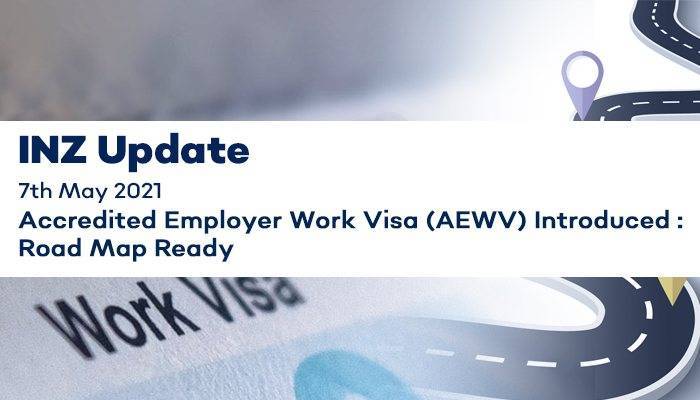
    Accredited Employer Work Visa (AEWV) Introduced: Road Map Ready

    The first step toward change is awareness. The second step is acceptance. It’s time to say ‘Hello’ and accept the new Accredited Employer Work Visa (AEWV) introduced by New Zealand Government.

    This new visa type called AEWV will be introduced on 1 November 2021 and will replace 6 of the existing temporary work visa categories.

    So, let us begin by explaining what exactly is exciting about this new Temporary Work Visa System? It includes a simple 3-ways check visa application system. Therefore, no need to get puzzled up with the old and new rules till another amendment comes into effect. Take a sneak peek to avoid confusion.

    This is an employer-led system, which simplifies the application process and makes it easier for businesses and regions to fill genuine skills shortages.

    Let’s understand the employer-led new 3-check visa process.

    Check 1 – Employers Check

    Accreditation has become mandatory for all employers before they hire any migrant.

    The accreditation levels are:

    • standard accreditation — for employers who want to have up to 5 migrant workers on AEWVs at any one-time
    • high-volume accreditation — for employers who want to have 6 or more migrant workers on AEWVs at any one time.

    Franchisees and employers wanting to place migrants on AEWVs with third parties (including labour-hire companies) will need to meet additional criteria to get accredited.

    Check 2 – Job Check

    This check will also confirm the job pays the market rate, the terms and conditions comply with NZ employment laws, and the employer has a labour market test to ensure there are no New Zealanders available to do the job that they want to fill.

    Check 3 – Migration Worker Check

    This is the last step in the AEWVs process. In this check, the migrant worker must show they meet INZ’s character, identity and health requirements, and meet the skills and experience stipulated as part of the employer’s job check application. If they meet all the requirements, they will be granted a visa to work in New Zealand.

    An All-Time Opportunity For Better worker protection

    This latest move will prove to be an important step to combat migrant exploitation by strengthening requirements on employers.  The changes are also necessary for encouraging employers to focus on ways to train and up-skill New Zealanders.

    The system will reduce New Zealand’s dependency on lower-paid temporary workers, and can address productivity, skills and infrastructure challenges altogether. This will also increase the skill levels of migrants.

    Important Dates One Need To Know

    30 June 2021 is the last date to apply for Accreditation under the current voluntary accreditation scheme.

    September 2021 is the month to apply for the new Accreditation.

    Till 31 October, one can submit one of the visa types that is going to be changed/replaced.

    1 November 2021 the wait period will be over as the new AEWV policy will become effective and be active for both employer and migrants.

    If you want to know more about the new Accredited Employer Work Visa or if you have any queries, please contact us. Our team of experienced Licenced Immigration Advisers  is here to assist you with all your immigration-related queries and confusions, please contact us by sending an email at contact@nzimmigration.info or call us on +64 09 3790219

    Family Reunification: Critical Purpose Visitor Visa

    This immigration policy update related to new border exceptions will enable many families to reunite after months of separation. The New Zealand borders are currently closed to most travelers unless they enter New Zealand from a Quarantine-Free Travel Zone or hold a Critical Purpose Visitor Visa (CPVV).

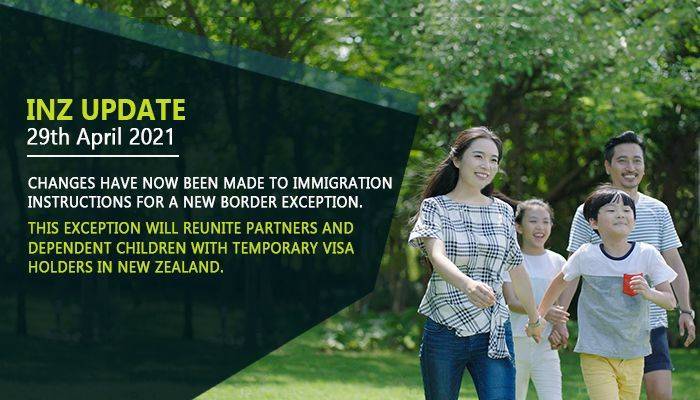
    Changes have now been made to immigration instructions for a new border exception. This exception will reunite partners and dependent children with temporary visa holders in New Zealand.

    As per these changes, The Minister of Immigration has expanded the CPVV category to include three categories (mentioned below). Applicants who fall under these categories may now be eligible for a CPVV provided they meet the eligibility requirement and are still in a genuine and stable relationship with their New Zealand partner.

    1. Partners and dependent children who hold a current visa based on their relationship to the person in New Zealand or have held a valid visa on 19 March 2020 but it has now expired because they were unable to enter New Zealand by the arrival date listed on their visa.
    2. Partners and dependent children of workers employed in critical health services.
    3. Partners and dependent children of highly skilled workers.

    For detailed information on the eligibility criteria for the categories mentioned above, please visit our INZ Update dated 19 April 2021.

    It is important to note that Immigration New Zealand is still keeping the CPVV alternative closed for the partner and dependent children of the Open Work Visa holders who may have occupations or critical health jobs. The prerequisite for CPVV at this time is that the visa should reflect that you are working in an occupation in critical health services.

    If you have any questions or require information regarding your situation, contact Immigration Advisers New Zealand Ltd at contact@nzimmigration.info or call on +64 09 3790219

    Current Partnership-Based Visa Instruction for The Partners of New Zealand Citizens and Residents When The Borders are Closed

    New Zealand border restrictions have kept many souls apart and this is a grim situation for the couples. But the situation is getting better for the couples staying miles apart because New Zealand borders are re-opened to those who are planning to reunite with their offshore partners. Hence, a celebratory moment for the ones who are living away from their families.

    Eligibility Criteria

    Immigration New Zealand instruction states that you may be eligible for the partnership-based visa if

    • your New Zealand partner is eligible to support your application; and
    • you and your partner are living together in a genuine and stable relationship; and
    • your partnership meets the Immigration NZ’s minimum requirement for the recognition of partnership; and
    health and character requirements are met.

    Partnership- based Visa categories

    Culturally Arrange marriage – Temporary visitor visa

    This category is for those who have married overseas to a New Zealand citizen or resident but were not able to live together after marriage due to work commitments. You must apply under this category within 3 months from the date of your wedding. To be eligible for this visa you must be able to demonstrate that the marriage follows an identified & recognized cultural tradition. You are also required to provide verifiable documentary evidence to show that you have a genuine intent to live together in a stable relationship.

    Partner of New Zealander – Temporary Visitor or work visa

    This requires you and your New Zealander partner to be living together in a genuine and stable relationship. You are required to provide verifiable documentary evidence to show that you meet the living together requirement. Based on the duration of your relationship/living together, you would be eligible for a visitor or work visa.

    Partner of New Zealander – Resident Visa (Onshore and offshore applicants)

    This requires you and your New Zealand partner to be living together in a genuine and stable relationship for at least twelve months at the time of lodgement of your application. You are required to provide documentary evidence for a minimum of 12 months to show that you meet the living together requirement.

    Critical Purpose Visitor Visa (Border exemption) Offshore applicants

    As per the criteria, citizens of ‘visa waiver’ countries are mandated to meet few policies, including living together in genuine and stable relationship criteria. For the ‘non-visa waiver’ countries the applicants should be ordinarily resident in New Zealand or traveling with their New Zealand partners.

    Common Factors considered by Immigration Officers

    ● Genuineness of the relationship
    ● Duration and stability of the relationship
    ● Financial dependence/interdependence
    ● Future commitment towards the relationship
    ● Children together and their care-taking arrangements
    ● Public recognition of the relationship
    ● Intentions for entering into the relationship
    ● Commitment to a shared life

    The most common reason for not receiving a partnership visa

    • INZ is not satisfied that you are in a genuine and stable relationship with a New Zealand citizen/resident.
    • There are outstanding Bona fides/Character issues/Health issues.

    These situations demand a well-skilled and informed expert who can assure your visa approval and this calls for experts’ assistance. Our team of experienced licensed immigration advisers is here to assist you with all your immigration-related queries and confusions, please contact Immigration Advisers New Zealand Ltd by sending an email at contact@nzimmigration.info or call us on +64 09 3790219