Provide All Relevant Information - Submit Query

Student Visa

Profile Check Form

Click Here ×
S
t
u
d
e
n
t

V
i
s
a

Get in Touch

    Some Respite For Partners And Dependent Children Of Temporary Visa Holders

    Partner and Dependent Children Of Temporary Visa NZ Holder

    How much you have waited to meet your loved ones! After getting the information below, a lot of families seem relieved that the wait is now over. Yes, Partners and dependent children of temporary visa holders who are currently outside New Zealand may be eligible to travel to New Zealand under this border exception category, which will come into effect on 30 April 2021.

    The border exception is for the following three groups:

    1. Partners and dependent children who held (and continue to hold) a visa for New Zealand but were unable to join their partner or parent in New Zealand before the border closed.

    To be eligible to enter New Zealand under this group, partners or dependent children outside of New Zealand must hold a current visa based on their relationship with the person in New Zealand. The partner or parent must be currently in New Zealand and have 12 months or more remaining on their work or student visa when the request to travel is submitted.

    1. Partners and dependent children of workers employed in critical health services.

    Doors are now open for Partners and dependent children of workers employed in critical health services who are currently in New Zealand and hold a valid visa for 12 months or more, specifying they work in an occupation needed to deliver critical health services in New Zealand.

    1. Partners and dependent children of highly-skilled workers

    Partners and dependent children of highly-skilled workers, working and living in New Zealand on a temporary visa that is valid for 12 months or more, earning at least twice the median salary, which is currently NZ $106,080 per year, are also now eligible for a border exception.

    The person in New Zealand must also meet one or more of the following:

    • they have unique experience and technical or specialist skills not readily obtainable in New Zealand
    • they have a role essential for the completion or continuation of a science programme under a government-funded or partially government-funded contract, including research and development exchanges and partnerships, and have the support of the Science, Innovation and International Branch at MBIE to carry out this work
    • A role essential for the delivery or execution of one of the following:
      • an approved major infrastructure project, or a government-approved event or a major government-approved programme
      • an approved government-to-government agreement
      • work with a significant wider benefit to the national or regional economy.

    In your request to travel, you will be asked to provide information from the person’s employer in New Zealand to prove eligibility.

    If your request is successful, you will be invited to apply for a visa. Your visa application must provide evidence of your relationship with your partner or parent in New Zealand.

    If you have any questions or require information regarding your situation, contact Immigration Advisers New Zealand Ltd at contact@nzimmigration.info or call on +64 09 3790219

    Reference: immigration.govt.nz

    Changes To NZ Labour Market Skills: Over And Under Supply Lists

    The New Zealand Government and the Ministry of Social Development (MSD) have created lists of occupations and regions facing clear over-or under-supply of New Zealanders.

    The lists are continuously updated to ensure that the oversupply and undersupply occupations are aligned to the changes in labour market conditions. In pursuance of this policy, from 16 April 2021Immigration New Zealand (INZ) will use the updated lists to assess Essential Skills Work Visa applications paid below the median wage.

    The Covid-19 pandemic has had a significant and evolving impact on migration flow and the labour market in New Zealand.

    With the new changes, INZ has stated clearly that employment opportunities are to be offered to as many New Zealanders as possible.

    The overseas workers may be allowed work visas where they can demonstrate that there is a genuine labour shortage. As per the already laid down policy, INZ asks New Zealand employers to list job vacancies with Work and Income to determine whether local workers can fill the role first. If that’s not possible, a Skills Match Report (SMR) is accepted in support of a work visa application.

    After considering various factors, INZ has introduced changes to the requirement for an SMR for occupations on a Labour Supply List.

    Labour Market List

    The MSD has come up with the occupations lists and regions where there is an obvious oversupply or undersupply of New Zealanders who are available to work in those specific occupations to make it easier for employers to find the information relevant to their business.

    From 16 April 2021, Immigration New Zealand will use the updated lists to assess Essential Skills work visa applications that are paid below the median wage.

    Additional jobs are being added to the undersupply lists in various regions, which implies that SMR will not be required with work visa applications that are paid below the median wage. Employers will still need to advertise their job vacancies and demonstrate they have made genuine attempts to attract and recruit suitable New Zealanders.

    Whereas no such improvisations are incorporated for the oversupply lists for any region. In fact, several roles are being removed from the list, and the employers will need to provide an SMR for roles paid below the median wage unless the role is on the undersupply list.

    Other changes include adding the ANZSCO codes for each role to improve consistency and simplifying the steps for checking whether an employer needs an SMR.

    If you have any questions or require information regarding your situation, contact Immigration Advisers New Zealand Ltd at contact@nzimmigration.info or call on +64 09 3790219.

    NZQA Update: Change To Student Fee Protection (SPF) Rules

    The New Zealand Qualifications Authority (NZQA) has an update regarding the new set of rules aligned for the Education and Training Act 2020 with minor correction and one rule change to the Student Fee Protection (SFP) Rules. However, it will not change the previous requirement for a student.

    The new SFP Rules aimed to ensure that students should be treated equally and fairly in all the events (that included programme or training scheme) if they are not participating in a course.

    As per the rule, PTEs cannot retain students’ fees on the grounds of a ‘no-show’/no-participation by a student. In this condition, they are liable to get a full refund less the statutory amount PTEs are entitled to retain.

    The new SFP rule is:.

    Rule 4.2

    In the following situations, a Student must be treated as having withdrawnwithin the Refund Period, from a course in which the student was enrolled with provider:.

    (a) where the student fails to attend or participate in the course; or.

    (b) where the student attends or participates in the course during the refund period but stops attending or participating in the course before the end of the refund period..

    4.3 Rule

    4.2(b) does not apply where the student attends or participates in that course after the end of the refund period..

    As a consequence of this change, some students may decide not to contact the PTE to withdraw when they should have done so formally. Hence, this rule change will place greater responsibility on the Private Training Establishment (PTE). They will need to clearly outline their withdrawal process, including the expectation to notify the PTE if a student decides to withdraw and for the PTE to follow up with a student who is not participating to confirm their intention..

    Please note that PTEs continue to be allowed by law to keep a certain proportion of the fees to contribute to their administrative costs..

    The Rule change also includes clarifying that a student who attends or participates at any point after the end of the refund period will not be considered as having withdrawn before the end of the refund period. Hence, PTE must attempt to contact the student to confirm their intention, and if appropriate, notify the student that they will be withdrawn from the course and receive any fee refund they are entitled to. However, if the student participates again, even intermittently, they will not be considered as withdrawn..

    If you need more information, please feel free to connect with Immigration Advisers New Zealand Ltd, talk to our Licensed Immigration Advisers and address all your concerns..

    Reference: https://www.nzqa.govt.nz/about-us/our-role/legislation/nzqa-rules/.

    Quarantine – Free Travel To Australia Announced, Working Holiday Schemes Deferred

    As you already know New Zealand is a country that has adopted a different approach, in the sense that only visitors traveling from safe zones in Australia will not be required to enter managed isolation or quarantine on arrival in New Zealand.

    The first quarantine-free travel destination in these pandemic times will be available for travel-starved people from 19 April 2021. This will allow more movement between New Zealand and safe zones in Australia. The government of New Zealand said it will open visitors’ movement between the country and from safe zones of its neighbor country, Australia.

    It’s important to make a note that the border rules are subject to change so travelers must prepare for disruption to their plans keeping in mind the worst-case scenario.

    Eligibility Requirement

    All the immigration requirements are to be followed which includes that one should have spent a minimum of 14 days in either of the two countries.

    Another good news for those who had COVID-19 tested positive, they can actually travel with a piece of written advice from their health practitioner declaring that they are no longer infectious.

    However, the citizens of both countries are allowed to travel cross- borders!

    Note: Quarantine – Free Travel is only permitted on commercial airlines. Border restrictions remain in place for private flights and maritime borders.

    Working Holiday Scheme

    On the other hand, New Zealand’s Working Holiday Schemes allow visa holders to work in and explore our country.

    In April 2020, the Government deferred the opening of capped Working Holiday Schemes, as part of New Zealand’s response to COVID-19.

    On 6 April 2021, the Government decided to continue deferring the opening of all capped WHS until the New Zealand border settings are such that applications can be accepted and processed, visas can be granted, and visa holders can travel to New Zealand for the full entitlement of their WHS visa.

    Uncapped Working Holiday Schemes remain open to people already in New Zealand. However, when New Zealand enters a Quarantine-Free Travel Zone with Australia, eligible applicants in Australia will also be able to apply for a visa under the uncapped schemes. This would apply if New Zealand enters Quarantine-Free Travel Zones with other countries as well.

    INZ continues to work with temporary migrants and sectors affected by the COVID-19 border restrictions.

    If you have any questions about the Quarantine – Free Travel, please email Immigration Advisers Nee Zealand Ltd. at contact@nzimmigration.info or call us on +64 09 3790219

    Ref – immigration.govt.nz & covid19.govt.nz

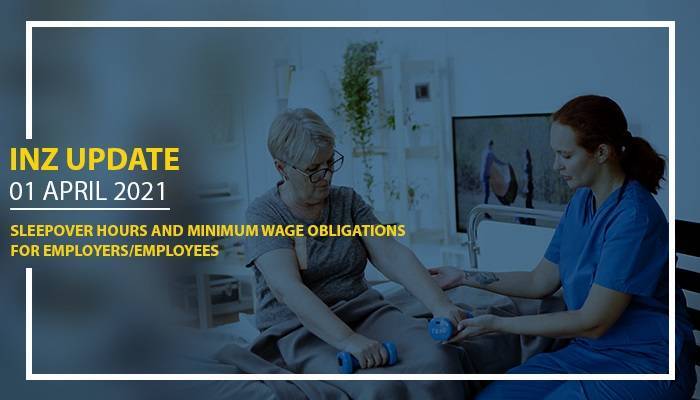
    Sleepover hours And Minimum Wage Obligations For Employers / Employees

    Update on Sleepover hours in the aged and residential care industry

    Sleepover hours in the aged and residential care industry

    Immigration New Zealand’s Visa Pak issue 465 dated 1st April 2021 has issued a clarification on rules for sleepover clauses in employment contracts. This immigration communique will clarify the impact on the processing of both Essential skills and Skilled Migrant Category visas.

    Some employment agreements in the Aged and Residential Care Industry include a sleepover clause where the applicant is paid lesser than the standard amount (currently $25.50) for the hours where they are allowed to sleep during the shift.

    Immigration Instruction SM6.20 (g) states that each hour of work must be paid at or above the applicable per hour remuneration threshold.

    Some employment agreements in the Aged and Residential Care Industry include a sleepover clause where the applicant is paid below the applicable remuneration threshold (currently $25.50) for any hours the applicant is allowed to sleep during a shift. Sleepover hours are considered hours of work as the sleepover is an activity performed for gain or reward and is not an activity excluded from the meaning of ‘work’ under immigration instructions (W2.2.1). If an applicant is paid less than the remuneration threshold for sleepover hours included in their contract then SM6.20(g) is not met.

    Sleepover Hours

    To make it easier, let’s take the help of a hypothetical example.

    Example: John works as a care worker with sleepover shifts included in his contract. During his shifts, he is allowed to sleep if his services are not required (this is allowed only under some conditions). He is provided with suitable facilities to allow him to sleep at his workplace.

    This means that sleepover hours are considered hours of work as the sleepover is an activity performed for gain or reward during his work hours and is not an activity excluded from the meaning of ‘work’ under immigration instructions (W2.2.1). So, if John is paid less for these hours than the standard amount, SM6.20 (g) is not met.

    As per the immigration instruction WK3.5.5 (g), payment for each hour should be at least $25.50 for employment to be identified as paid at or more than the average wage. (Refer to WK3.5.1.b).

    For situations where the total wage criteria are not met, the immigration visa officer would provide an applicant with the opportunity to comment before a decision is made on his/her application. Here he or she is free to re-submit the contract without adding the sleepover clause or the employer can reconfirm the amount to be paid for sleepover hours.

    If you want to know more about the sleepover hours or how it impacts the assessment of concerned visa types, contact Immigration Advisers New Zealand Ltd at contact@nzimmigration.info or call on +64 09 3790219

    New Zealand Border Exception Criteria For Partners And Dependents Of Citizens/Residents

    Do you wish to enter New Zealand? If the answer is yes, you must be aware of the options Immigration New Zealand (INZ) has for you.

    Even though the borders are currently closed for most travellers, partners of New Zealand citizens/residents can travel to New Zealand if they hold a critical purpose visitor visa or relationship-based visa. As you would already know, entry to New Zealand from all countries remains strictly controlled to prevent the spread of COVID-19.

    Partners of New Zealand resident/citizen who are currently outside New Zealand

    Those applicants who do not hold a relationship-based visa and are currently outside New Zealand can apply for a border exception.

    However, to do that under this category and criteria, you must prove that you are in a genuine and stable relationship and intend to travel to New Zealand with your New Zealand partner(citizen/resident). You can include even dependent children in the application.

    Border Exception Process

    The first step is to request a border exception called an Expression of Interest (EOI) by INZ. This EOI is not a visa application but a request form that only lets you explain your circumstances in 3000 words. There is no option to upload any documents, and you have to explain in limited words how you think you meet the relevant immigration instructions to qualify for a border exception. The fee for this request is NZD 45 as of date.

    If INZ is satisfied that you meet the requirements based on the information provided in the request form, they will issue an ‘Invitation to Apply (ITA)’ for a Critical Purpose Visitor Visa (CPVV). This will be an actual visa application wherein you will be requested to lodge a formal application and submit the relevant supporting documentary evidence to prove that you live together in a genuine and stable relationship with a New Zealand resident/citizen. The fee for this application is NZD 246. If the CPVV is approved, you can travel to NZ with your partner.

    Partners or dependents of a New Zealand citizen or resident ordinarily residents in New Zealand but do not have a relationship-based visa can also request border exception. If their request is approved, they will then be invited to apply for a visitor visa, another visa that suits their circumstances or to vary their existing visa to allow them to travel. The process remains the same as explained above, and you would need to demonstrate that you are in a genuine and stable relationship with your New Zealand partner(citizen/resident). The only difference here is that the NZ partner does not need to accompany the applicant.

    Partners or dependents of a New Zealand citizen/resident currently out of New Zealand but have a valid partnership-based visa or dependent visa.

    Those applicants will be able to travel on that visa. There is no need to apply for a border exception, nor are they required to travel along with the NZ partner.

    Note – the process varies slightly for applicants who are Australian citizens/residents.

    Reasons for not receiving an ITA:

    • INZ is not satisfied that you are in a genuine relationship with an NZ citizen/resident.
    • There are outstanding bona fides/Character issues/Health issues.
    • INZ has identified bona fides/Character issues/Health issues in the border exception request.

    This process may appear to be straightforward; however, it involves a lot of intricacies. There are many complexities involved in determining if you may be eligible to travel to New Zealand during the current border closure. The threshold is very high to be granted a border exception/relationship-based visa. The onus lies on the applicant to satisfy the Immigration Officer that he/she meets the relevant instructions. The Immigration Officer is not obliged to seek further information/documentation and decide the application based on the information on hand.

    If you are not sure if you meet the requirements for a critical purpose visa/relationship-based visa or would like to know how you may be able to qualify, please contact Immigration Advisers New Zealand Ltd by sending email at contact@nzimmigration.info or call us today on +64 09 3790219

    How To Reduce Evidence Of Funds Required By An International Student To Study In New Zealand

    New Zealand Continued Border Closure

    It is now an irrefutable fact that New Zealand has become one of the best countries to gain a higher qualification. All the universities of New Zealand rank in the top 3% of universities in the world. It is considered one of the safest countries for international students, even more so due to how they have handled the pandemic.

    For the continued safety of people inside New Zealand, until international travel becomes safe, New Zealand has currently suspended processing offshore student visas. The next intake that is being currently looked at by the international students is January 2022.

    Online Studies – Cost-effective

    New Zealand’s education providers to assist prospective international students looking to come and study in New Zealand once the borders open have come with multiple online study options. This will significantly reduce the evidence of funds required to be submitted by a student when applying for a student visa to Immigration New Zealand (INZ).

    Reduced Funds Requirement

    An international student needs to provide evidence of the funds to pay for tuition fees and the cost of living for the course duration to INZ. Identifying this as an opportunity to help prospective international students during the pandemic, most education providers now provide a platform to study a part of the qualification online.

    This is very beneficial to the student, as part of the courses being offered online has lower tuition fees. Many education providers are giving scholarships and discounts to study their courses online.

    A student can save approximately 20% of the total tuition fee payable for the course on average. Additionally, there is no requirement to incur any associated costs like student levy fee, insurance etc. Students also do not have to cater to the living cost for the entire duration of the course. All this helps an international student budget and reduce international education cost.

    Benefits Of Online Course

    There are many online courses that education providers are currently offering. These could be Diploma’s, Bachelor or even Masters; however, care needs to be taken only that part of the course is done online, which does not affect the Post Study Work Visa.

    The student can study one paper for up to two years from the comfort of his/her home. Studying online is beneficial to the students in terms of financial gain and helping them familiarise themselves with the education system of New Zealand.

    One of the challenges an international student faces when studying overseas is the country’s different education system. They struggle to settle in a new country and adjust to the new education system, which would differ from their home country. Learning a part of the qualification online helps them to become familiar with the requirements.

    They understand the process of writing an assignment and attempting exams. This helps them to settle faster when they come to New Zealand and start studying face to face.

    Cross Credits and Recognition of Prior Learning (RPL)

    All the papers or courses which a student does online will be cross credited. It means that the student will not be required to repeat those papers when they come to New Zealand to complete their qualification.

    For example, if a student has applied for a Masters, which has 180 credit points, then studying 60 credits online will only leave the balance of 120 credits to be studied in New Zealand.

    Education providers of New Zealand also recognise qualifications gained by the students in their respective home countries. If a student is planning to study a qualification in New Zealand and feels that they have done a part of that qualification in their home country, they can request the education provider to consider recognising their previous qualification and provide them with credits. This would help them to complete the desired qualification in a lesser time.

    An example would be when a student has completed or is studying a Bachelor’s qualification in the home country and is planning to continue the same in New Zealand. The education provider can compare the course offered in their home country with their own qualification and provide cross credits. This would reduce the duration of completing the Bachelor’s in New Zealand and allow the student to complete the course faster. This not only reduces the duration of the course but also reduces the financial requirements.

    Dual Qualification

    Some education providers are offering certificates on completion of the online course. For example, if you complete 60 credits of the Masters course, you will receive a post-graduate certificate, a New Zealand governments recognised qualification. Once you continue and finish the New Zealand qualification, you will get another certificate for completing your Master’s course.

    Post Study Work Visa

    New Zealand provides post-study work rights to international students who successfully meet the designated qualification criteria. The duration of the post-study work rights depends on the qualification international student completes in New Zealand. This ranges from one to three years. The provision of post-study work rights provided by New Zealand is an excellent way to familiarise themselves with the work opportunities.

    Contact Us

    If you are an international student planning to study in New Zealand, please contact us at Immigration Advisers New Zealand Ltd. Our Licensed Immigration Advisers team will help you select the right course and education provider and get the best cost reduction benefits. We will guide you to use the opportunity to do part of the course through online studies and reduce the evidence of funds required to be submitted with your student visa application when lodging it is INZ.

    How To Get Prior Learning Or Experience Credited To Get A New Qualification In New Zealand

    Cross Credit and How International Students in NZ Can Save Time and Money

    Due to the pandemic, New Zealand borders are closed. However, this doesn’t mean the international students who want to study in this island nation have to “wait” for things to get back to normal. In addition to enhancing their skills and knowledge, they can do several other things to save their time and money when they do get enrolled in a college/university program.

    Benefits of Cross Credit

    If you’re clear on which New Zealand university you want to study in and what program you want to pursue, find out chosen program’s curriculum/structure and what type of papers it includes. Once you know about the courses, find a similar course online and sign up for them. Provided the course you did was relevant and successfully-completed, you could be eligible for credit recognition. This will allow you to reduce the number of papers you need to take at the diploma, bachelors (undergraduate) or post graduate level. Subsequently, this will also help international students save time and money. However consultation needs to be done with a License Immigration Adviser around the impact of duration of post study work visa rights.

    NZ Universities encouraging international students

    In fact, many top universities are recommending international students to apply for cross-credits. It’s worth noting, though, that different universities have their own requirements. So, the university you’re planning for admission into, make sure you understand their terms on cross-credits and how they deal with it. Some of them may happily apply cross-credits to your record, while others may not.

    In any case, you will have to submit academic transcripts or/and work experience that will prove you are eligible for the cross credits. You would also be asked several questions regarding the program or / and work experience and its relevance to you regarding the academic and career progression it offers to you. The university faculty will go through the application, your request, and then once you check all the right boxes, your cross-credits will finally be approved.

    If you need more information about cross credits and how it can save time and money in your studies for undergraduate Diplomas, Bachelors and Masters degree, please feel free to connect with Immigration Advisers New Zealand Ltd talk to our Licensed Immigration Advisers and address all your concerns.

    New Zealand Shifts To Mandatory Registration Of All Social Workers From 27 February 2021

    Mandatory registration is required by law from 27 February 2021 for all social workers to undertake employment in New Zealand. Residence immigration instructions have been amended to incorporate Social worker occupation to the list of occupations requiring registration under the Skilled Migrant Category (SMC).

    Social workers provide care, advice and support to people with personal or social problems and help with community and social issues.

    All social workers now need to be registered with the Social Workers Registration Board (SWRB). To gain clarity it is good to know that you need to be registered if you:

    • call yourself a social worker,
    • are known as a social worker, or
    • are held out to be a social worker.

    Those who do not have an SWRB-recognised social work qualification but have practical social work experience in New Zealand, may still be eligible to register under the experience pathway.

    How to enter a job of a Social Worker?

    To become a social worker, you need to have a recognised qualification, such as:

    • Bachelor of Social Work
    • Bachelor of Applied Social Work
    • Bachelor of Bicultural Social Work
    • Master of Applied Social Work
    • Master of Social and Community Work (Applied)

    The Government employs most social workers.

    • District health boards employ 23% of registered social workers
    • Oranga Tamariki-Ministry for Children directly employs another 22% of registered social workers and funds social workers in community organisations.

    Other employers are not-for-profit, iwi and Māori agencies, the education sector and private practices. Four per cent are self-employed. Most social workers are in full-time work, but 20% work part-time.

    If you are interested in obtaining an SWRB-recognised qualification to become a registered social worker or discuss the possibility of applying for residence, please email Immigration Advisers New Zealand Ltd contact@nzimmigration.info or call us today on +64 09 3790219.

    New Zealand Government Moves To Stabilise International Education Sector

    New Zealand is one of the most preferred educational destinations globally and has attracted students worldwide. Unfortunately, the educational sector is one of the most affected sectors due to the pandemic. However, the government knows the vital role international education will play as the economy recovers and rebuilds.

    Therefore, in response to the pandemic, the New Zealand government has announced a long-term strategic recovery plan, supported by a $51.6 million investment from the COVID recovery and response fund to help stabilize New Zealand’s international education sector.

    The recovery plan comprises three parts that will run concurrently and focus on stabilizing the international education sector, strengthening it via regulatory settings, policies, and practices, and accelerating its transformation as signalled in 2018’s International Education Strategy.

    The government aims at investing in the international education recovery fund in several ways, as mentioned below.

    • $20 million will support the state and state-integrated schools.
    • $10 million will support Private Training Establishments (PTEs).
    • $1.5 million will go to the English Language Schools to deliver English language training to migrants.
    • $500,000 will go to the New Zealand Qualifications Authority (NZQA).
    • $6.6 million will be spent to ensure pastoral care and other activities for international students.
    • $10 million will be spent developing future-based products and services to drive higher onshore and offshore growth.
    • $3 million is kept for Education New Zealand (ENZ) brand’s marketing in the relevant international market.

    By implementing this comprehensive recovery plan, the government anticipates minimizing the impact on the educational sector.

    The fund allocation intends to strengthen the country’s existing education system with a higher appeal and resiliency that attracts more international students as the world looks to recover from the pandemic.

    The Education Minister of New Zealand has said that ultimately what the government wants is to have an international education system that’s mutually good for students, education providers and benefits New Zealand economically and socially.

    He also said that he is aware that much of the recovery is dependent on when New Zealand will open its borders to international students, and providers are eager to get timeframes on when any changes to the border closure will be made.

    New Zealand Dairy Sector Update: Skilled Occupations

    Changes have been made to Residence and Temporary Entry immigration instructions by Immigration New Zealand (INZ) to reflect new task descriptions developed by Statistics New Zealand, for three dairy roles under the occupation Dairy Cattle Farmer (ANZSCO 121313).

    With effect 15 February 2021, INZ will now assess the following roles based on version 1.3 of the Australian and New Zealand Standard Classification of Occupations (ANZSCO), provided by Statistics New Zealand in their Ariā classification management system :

    • Dairy Farm Manager (Skill Level 1)
    • Assistant Dairy Farm Manager (Skill Level 3)
    • Dairy Herd Manager (Skill Level 3)

    In the past, only Dairy Farm Managers were considered as skilled occupation by INZ for residence under the Skilled Migrant Category (SMC). This is a skill level 1 occupation on ANZSCO which requires either a bachelor’s degree or five years’ experience. Not everybody could meet the qualification and/or experience requirements for the skill level 1 position, thus preventing many dairy farmworkers from applying for residence under the SMC.

    What Does The Change Mean?

    The recent change now means that applicants will now also be able to apply for residence based on the above two skill level 3 positions provided they can meet the other eligibility requirements. Skill level 3 occupations generally require either three years of relevant work experience or a level 4 qualification.

    The other dairy farm occupation on the earlier version of ANZSCO is that of a Dairy Farm Worker, a skill level 5 position that made it difficult for many other farmworkers who did not meet the requirements for the skill level 1 position to apply for residence.

    The newly introduced changes will now open pathways for residence for a large number of dairy farmworkers, and will also go a long way in addressing the manpower challenges faced by employers in this industry.

    If you are working in the dairy industry or planning to take up a role, and would like to discuss the possibility of applying for residence, what it involves or whether you qualify, please email Immigration Advisers New Zealand Ltd at contact@nzimmigration.info or call us today on +64 09 3790219

    New Zealand Revives Its Economy And Employment While Keeping A Close Eye On Immigration

    Economy Back On Track

    The pandemic hit New Zealand’s economy in a significant way. However, even as the world scrambles towards the vaccine, owing to its strong base and robust measures, the country’s economy, including the job market seems to be getting back on track.

    The country’s most significant job advertising site, Seek, has reported a 19% national growth in jobs advertised in the final quarter of 2020. The number of job advertisements on the website has bounced back to nearly pre-pandemic levels.

    Finance Minister Grant Robertson says the national unemployment rate in the December 2020 quarter is promising and the trend is continuing to prove strong heading into 2021.

    Unanticipated Decline In Unemployment Rate

    The employment data from Stats NZ reflects the favourable impact of the New Zealand government’s decisive actions taken to stimulate economic recovery.

    The sectors posting the most vacancies on Job sites included IT and communications, manufacturing, transport & logistics and trades & services. However, jobs in customer-facing roles have taken a massive hit. Despite this Stats NZ said the third-quarter growth was the strongest in New Zealand’s modern history, coming off an 11% drop in the June quarter.

    Off late various indicators have conveyed that New Zealand economy is bouncing back better than expected, and labour shortages are being experienced across many industries.

    That’s good news for the citizens and the onshore migrants whose skills are back in high-demand. To ensure a consistent supply of labour to the local businesses, Immigration New Zealand (INZ) has decided to extend several work visas automatically for a defined period. These changes have impacted a large number of 192,000 migrant workers who are in New Zealand.

    Immigration Policy Changes

    Employers-assisted work visa holders whose visas were due to expire before 30th June 2021 now had their visas extended automatically for another six months. The Essential Skills Work Visa holders (earning less than $25.50) who otherwise had to leave New Zealand for 12 months after working in New Zealand for three years have their stand-down period postponed until January 2022. The Working Holiday visas stand extended for six months.

    These changes have been made to ensure the consistent accessibility of migrant workers for New Zealand employers. The visa extension is not a guarantee, and the visa holder must meet the INZ requirements to have their visas extended.

    Similarly, employers in New Zealand must adhere to the laws and regulations when hiring migrant workers. They would do well to note that while these changes allow employers to retain existing migrant workforce, they still need to undertake Labour Market Test (LMT) before hiring new employees.

    The potential completion of the COVID-19 vaccination programme in 2021 can now only further the recovery being experienced.

    Have a Question?

    If you are confused or have any queries, please get in touch with us. Talk to our licensed immigration advisers and have a proper understanding of these changes – and how they might affect you. Click here and get in touch with our team.

    New 3-check Work Visa Application Process Being Introduced In Mid 2021

    New Temporary Work Visa System Overview

    Immigration New Zealand (INZ) is introducing a slew of changes to existing temporary work visa settings. The changes that will come into effect after mid-2021, include a new 3-check visa application system and a new visa that will replace six of the existing temporary work visas.

    The new 3-check visa application process will be employer led, which means that before hiring a migrant on this new work visa, employers will need to:

    • apply for accreditation
    • apply for a job check to make sure the role they want to fill cannot be done by New Zealanders, and
    • request a migrant worker to apply for a visa.

    While several questions remain unanswered, it is expected that INZ will release further information on the proposed changes in the coming weeks. These changes are being introduced with the intention of streamlining the current work visa system, minimising the potential exploitation of migrant workers, and to ensure more employment opportunities for New Zealanders.

    Know The 3-Check Process

    Check 1: Employer check – Before hiring any migrant worker, the employer will need to apply for accreditation. This “employer check” will replace three existing employer schemes (other 3 are mentioned below):

    • Accreditation as a Talent Accredited Employer (to be replaced);
    • Approval in principle (AIP) before an employer hires worker on an Essential Skills Work Visa (to be replaced);
    • Labour Hire employers accreditation for Essential Skills Work visas (to be replaced).

    There will be two main accreditation levels that employers can apply for – standard accreditation and high-volume accreditation. Both levels will have their own set of criteria.

    Check 2: Job check – Before hiring any migrant worker, the employer must demonstrate that the job position that needs to be filled cannot be filled by New Zealanders. Applying for this “job check” will confirm that the job pays the market rate, complies with employment laws, and the employer has done a labour market test if needed.

    Check 3: Migrant worker check – This is where the migrant worker will apply for a visa. The migrant applying for the visa must fulfil the basic requirements of character, identity, and health. The migrant worker must prove that they indeed have the skills and/or qualification to fulfil the job they are aiming for. If they meet all the requirements, they will be granted a visa.

    Who Are Affected (And Who Aren’t)?

    This new employer-assisted work visa will replace six existing work visas: Long Term Skill Shortage List Work Visa, Talent (Accredited Employer) Work Visa, Essential Skills Work Visa, Essential Skills Work Visa — approved in principle, Silver Fern Job Search Visa (closed 7 October 2019), Silver Fern Practical Experience Visa.

    Please note, however, that this new visa system will not affect or change other temporary work visas such as Specific Purpose Work Visa, Post-study Work Visa, Religious Worker Work Visa, and more.

    Confused? Need Help?

    If you hold a work visa that is affected by these announced changes and are uncertain about your future in New Zealand or if you are planning to apply for a work visa but are unclear of the process – get in touch with an experienced Licensed Immigration Adviser (LIA). Tap on their expertise to understand this new visa system, how it may affect you, and what steps you need to take. At Immigration Advisers New Zealand Ltd., we have a team of Licensed Immigration Advisers that has 50+ years of collective experience. Get in touch with us today and talk to one of the experts.

    Online Learning for International Students – Advantages, Limitations and Recommendations

    As the world scrambles to lay their hands on COVID-19 vaccine – online learning as an outcome of the pandemic related restrictions has become a prevalent choice for all. Prospective international students who are looking to come and study in New Zealand are looking at this option so as not to elongate their break from their studies.

    There is an old saying that necessity is the mother of invention, and it still holds as proved by the innovations recently introduced in the online learning space. We can see from the universities initiatives that enrol international students, many of whom have returned to their home countries and now solely rely on e-learning platforms.

    Saves Cost of Living

    Much like anything, online learning has its shares of pros and cons. It boasts plenty of advantages. For international students, it saves the expenses of living in a foreign country. Even for the home-country students, the costs of commute and renting space near the campus are saved. Such savings can be a big difference-maker in affording a university education. Also, online learning comes with big convenience; you get to study from the comfort of your home, or wherever you are. It saves students’ time and from troubles of heading to classes.

    Enhanced Learning Experience and Returns

    Moreover, online learning can be more rewarding academically. The top universities of New Zealand have built a robust and intuitive infrastructure that promotes better understanding and more rewards; students can learn better and more effectively, which enriches them with enhanced skills and knowledge and inevitably gets them the desired grades.

    Lack of Sociability

    But all said, e-learning also has several limitations that cannot be overlooked. For one, it lacks the social aspect that students often seek and enjoy in their college life. There’s little room to meet new people and build new connections, which are incredibly important for various reasons. It helps improve students’ interpersonal skills. Also, building a network of classmates and faculty members is very helpful to discover more career opportunities.

    Maximize the Benefits, Minimize the Cons

    Students who rely on online learning are often advised to maximize this model’s pros and minimize the cons. If you’re e-learning, with the time you save, it’s essential to get other aspects of your life on track. This includes your health and fitness. Invest efforts and resources in getting yourself physically and mentally healthier. Take up extra classes and signup to other programs that can add to your skills and qualifications.

    Similarly, make efforts to communicate more with your teachers and classmates. If there are open platforms/forums available in your online classes, ask more questions and help others with answers. Reach out to more people; a simple ‘hey’ can be the start of a long friendship. Participate in different activities that aim at connecting people and building network.

    In all, as mentioned earlier, online learning has advantages and disadvantages. It comes down to the students how they make the most of this learning model.

    English Eligibility for International Students When Applying to Study in New Zealand

    Types of Education Providers in New Zealand

    International students who want to pursue higher education in New Zealand must first apply for an offer of a place to an education provider. There are three main types of education providers in New Zealand. These are Private Training Establishment (PTE), New Zealand Institute of Skills and Technology (NZIST) formerly known as Institutes of Technology & Polytechnics (ITPs), and University. Study programmes designed for international students are regulated within the New Zealand Qualifications Framework (NZQF). New Zealand Qualifications Authority (NZQA) is responsible for quality assuring all courses and tertiary education organisations other than universities. The Committee on University Academic Programmes (CUAP) and the Academic Quality Agency (AQA) have delegated authority for quality assurance of university education.

    English Eligibility to Study in New Zealand

    For PTE, and NZIST the NZQA sets English language entry requirements for international students through the NZQF Programme Approval and Accreditation Rules 2018 and the Training Scheme Rules 2012. If the approved entry requirements for a specific programme are higher than those listed in Rule 18, the student must meet the higher level required by the provider. There is a range of evidence that providers can use to verify an international student’s English language proficiency.

    All education providers are responsible for ensuring that the international students they enrol, have the required level of English language proficiency for the level at which they intend to study. Students can prove this by submitting evidence of an approved English language test or prior study in the English medium.

    So, if you want to study in New Zealand, you’ll have to meet the English language entry requirements for international students.

    Which Test to Take?

    There are several standardized English proficiency tests that education providers in New Zealand accept. They use it to verify an international student’s English language proficiency. The details are listed on the NZQA Website and mentioned in Rule 18.

    NZQA has also provided a Table of English language proficiency outcomes for international students on their website, which sets out the approved test, and required outcomes. International students may use these tests as evidence of English language proficiency for international students who are enrolling in different levels of study programmes.

    How Much Do You Need to Score?

    Every education provider has its baseline requirements as per the study programme they offer to international students. For instance, if you’re applying for program level 9-10, which includes Master’s degree and Doctoral Degree, you are usually needed to score overall 6.5 Bands in Academic International English Language Testing System (IELTS) or its equivalent and acceptable test.

    Since the English proficiency test is mandatory, and education providers prefer students with a certain level of the score, students need to spend enough time in preparation. Irrespective of which test you’re taking – TOEFL, IELTS or PTE – they will each test your English reading, listening, speaking, and writing skills through various sections.

    Have Taken the Test – Now What?

    Once you have given the test – and have scored sufficient to what the education provider of your choice requires – you can commence the admission process. We the Immigration Advisers New Zealand are an Education New Zealand Recognised Agency (ENZRA) and represent most education providers in New Zealand. We have a dedicated team of education/career counsellors and admission processing team in place to assist you.

    In the early stage, you will be asked for your academic documents, and work experience evidence (if applicable) along with the score of your English proficiency test. As your application process moves forward, the score you submitted will be verified by the education provider. In case your score for some reason does not meet the required level, you can always retake these tests. Certain education providers can also provide you pathway offer of a place with which you can lodge your pathway student visa.

    Get Help With NZ Student Visa

    If you need more assistance with the admission process, consider contacting our team of education counsellors. For help with New Zealand Student Visa, get in touch with Immigration Advisers New Zealand Ltd. IANZ is one of the leading immigration services providers in Auckland, trusted by hundreds of international students with their end-to-end visa needs and problems.